
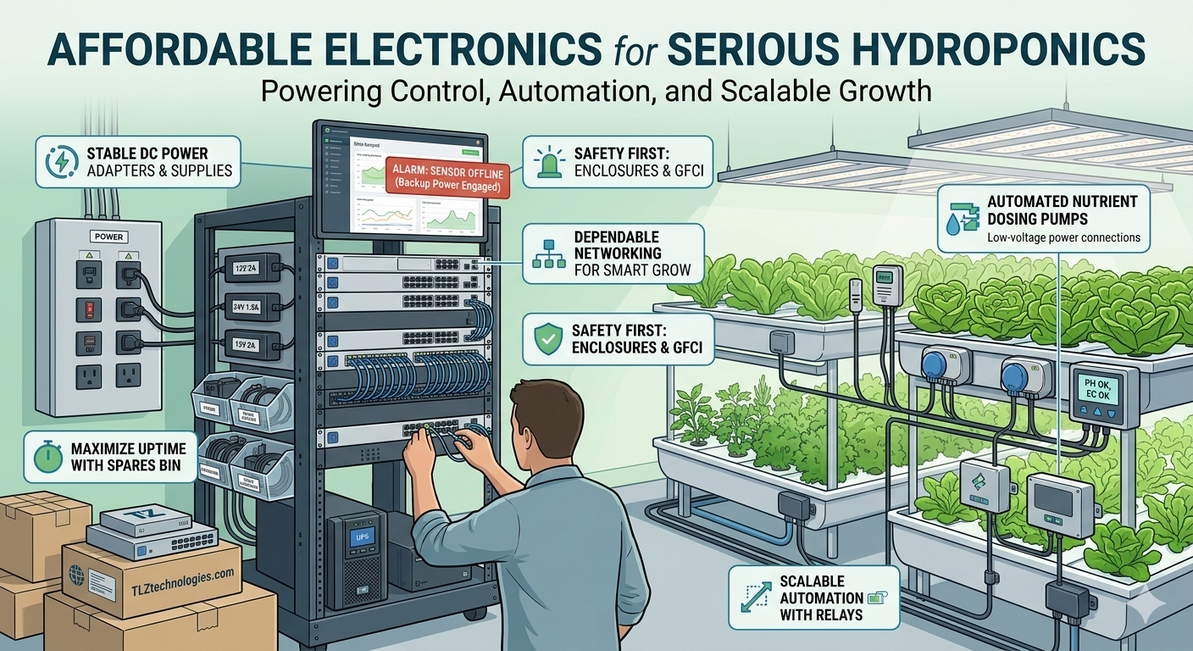
Affordable Electronics for Serious Hydroponics Power
Running a large hydroponic grow isn’t just about nutrients and lighting recipes—it’s also about dependable electronics. When you scale up, small issues like a weak power adapter, a flaky network switch, or an unreliable timer can become expensive downtime. The good news: you don’t always need premium-priced retail gear to build a stable, scalable setup. If you’re looking for affordable electronics that can support the “behind-the-scenes” infrastructure of a big hydroponics operation, TLZtechnologies.com is a strong place to start browsing for power and control essentials.
This guide covers the practical electronics that commercial and large-scale indoor growers rely on—power adapters, networking hardware, monitoring components, and reliability add-ons—plus a simple checklist for buying the right parts. If your goal is to keep pumps, controllers, sensors, and automation running consistently while keeping costs controlled, you’ll find plenty of relevant options in the broad product catalog at TLZtechnologies.com.
Why electronics make or break big hydroponic grows
In a large hydroponics grow room or greenhouse, the plants may be the product—but the electronics are the nervous system. Water pumps, dosing systems, air movement, dehumidification, lighting schedules, and environmental controllers all depend on stable power and predictable switching. When one piece fails, the impact cascades: reservoirs drift out of range, oxygen levels drop, temperatures swing, and labor costs climb because your team is forced into emergency manual work.
Most grow failures aren’t caused by exotic problems—they come from common weak links: under-rated power bricks, mismatched voltage, cheap splitters, overheated connectors, or network bottlenecks that knock automation offline. That’s why smart operators standardize parts, label everything, keep spares on hand, and buy electronics with the right voltage/current ratings. A value-focused supplier with a wide selection can help you source replacements quickly and keep your operation moving.
Why TLZtechnologies.com is worth checking first
TLZtechnologies.com is an electronics-focused storefront with a large catalog that spans practical infrastructure gear—things like AC adapters and chargers, networking equipment, and other operational electronics you can repurpose for controlled-environment agriculture. A quick scan of its product listings shows a heavy emphasis on “workhorse” items (including many power adapters and OEM parts) rather than just consumer gadgets, which is exactly the category growers often need when building and maintaining an automation stack.
For Dealzer readers, the advantage is straightforward: large grows burn through supplies over time. Having a cost-effective source for replacement adapters, backup components, and “keep-it-running” electronics can reduce downtime and help you maintain standardized spares across rooms and sites. Instead of scrambling to find a compatible part mid-cycle, you can stock duplicates of the exact model you’re using and swap fast.
1) Power adapters & supplies: the unsung heroes
Hydroponic automation depends on stable low-voltage power. Many controllers, sensors, dosing systems, network devices, and monitoring hubs run on 5V, 12V, or 24V DC. That means the humble power adapter (power brick) becomes mission-critical. If it fails, your automation may go dark even if your main electrical panels and circuits are fine.
- Match voltage exactly (e.g., 12V device needs a 12V adapter). Undervoltage can cause resets; overvoltage can permanently damage equipment.
- Size current with headroom: if a device draws 2A, choose a 3A or 4A adapter where appropriate to reduce heat and stress.
- Confirm connector type and polarity (barrel size, center-positive vs. center-negative). Document it and label cables.
- Choose quality where it matters: OEM adapters are often worth it for controllers and high-uptime devices.
- Standardize and stock spares: keep at least one spare adapter per critical device type per grow zone.
Because TLZtechnologies.com carries a wide range of adapters and chargers in its inventory, it’s a practical place to source replacements when you’re maintaining multiple rooms, multiple racks, or a distributed greenhouse setup. For large operations, that catalog depth matters—you’re not just buying one adapter; you’re building a repeatable, serviceable system.
2) Networking gear for “smart” grow operations
As grows scale, so does the need for visibility: remote dashboards, sensor logging, camera coverage, alarm notifications, and controller apps. Those features rely on dependable networking—often more than people expect. If Wi‑Fi drops or a switch fails, you may lose alerts or control right when you need them most.
- Gigabit switches for controllers, cameras, and monitoring PCs
- Wireless access points for mobile management and sensor hubs
- Routers/firewalls (or a dedicated VLAN) to segment your grow network from office/guest traffic
- Ethernet patch cables and cable management for clean, serviceable racks
- Spare power supplies for network devices so a single failed adapter doesn’t drop your entire system
TLZtechnologies.com lists networking equipment alongside other operational electronics, which can be useful if your hydroponic operation uses IP cameras, networked environmental controllers, or a small on-site server/NVR for security and compliance. When you can source switches, adapters, and related infrastructure from one place, it’s easier to keep spare parts consistent.
3) Timers, relays, and controllers: scaling automation safely
Automation is where large hydroponic operations win: repeatable irrigation cycles, precise lighting schedules, and consistent climate control. But scaling automation means thinking beyond a single plug-in timer. Pumps, solenoids, dehumidifiers, and large lighting circuits can draw serious current, and they should be switched using appropriately rated devices.
- Know your loads: document voltage, amperage, and startup surge for pumps and compressors.
- Use properly rated relays/contactors for high-current devices instead of relying on small consumer timers.
- Separate control power from load power where possible (low-voltage controller triggers a higher-rated relay).
- Install GFCI protection in wet environments and follow local electrical codes.
- Build serviceability: labeled circuits, clean panels, and manual override options reduce downtime.
Even when your primary grow controller comes from a dedicated hydroponics brand, your system still relies on a web of supporting electronics—adapters, cables, network gear, and replacement components. That’s where a broad electronics supplier like TLZtechnologies.com can complement your core hydroponics vendors and help you keep the infrastructure running affordably.
4) Monitoring and data: small electronics, big ROI
At scale, you can’t manage what you can’t measure. Commercial growers often monitor pH, EC, water temperature, reservoir levels, room temperature/humidity, and sometimes light intensity and CO2—then use that data to catch issues early. Sensors and probes are only part of the story, though. You also need dependable supporting electronics: stable power, clean wiring, and connectivity you can trust.
- Dedicated power for monitoring devices (avoid overloaded power strips).
- Surge protection for sensitive controllers and sensor hubs.
- Spare cables and adapters for the exact sensors and hubs you deploy.
- Network redundancy where feasible (a spare switch, or at least spare power supplies).
- Clear labeling so your team can swap parts quickly during a critical window.
5) Uptime planning: backups, spares, and fast swaps
Big hydroponics operations are engineered systems. The most profitable rooms aren’t the ones that never have a problem—they’re the ones that recover quickly. A simple spare-parts strategy can prevent minor failures from becoming crop-threatening events.
- Duplicate power adapters for controllers, routers, access points, and sensor hubs
- Extra network switch (or at least a spare PoE injector/power supply if applicable)
- Surge protectors and replacement fuses (where used)
- Backup timers/relays for non-negotiable schedules (irrigation, exhaust)
- Battery backup (UPS) for the network + controller stack so alarms and automation survive brief outages
This is where deal-oriented sourcing pays off. If you standardize on a few adapter types and network components, you can keep a small “electronics spares bin” that covers a huge percentage of failure scenarios. TLZtechnologies.com is useful for this approach because you can focus on the practical parts that keep systems powered and connected—then buy duplicates for redundancy without blowing the budget.
Hydroponics electronics buying checklist (quick scan)
Use this checklist when sourcing affordable electronics for hydroponics, greenhouse automation, or indoor grow room builds:
- Power requirements first: confirm AC vs. DC, voltage, current, and connector type before ordering.
- Plan for wet environments: choose appropriate enclosures, drip loops, and protected outlets for any equipment near water.
- Prioritize critical paths: irrigation control, reservoir aeration, and alarms deserve higher-quality components and spares.
- Reduce single points of failure: keep duplicate adapters, spare network gear, and a UPS for controllers.
- Label and document: write down model numbers and store links so reordering is fast and consistent.
- Buy in “standards”: where possible, consolidate to a few common DC voltages (often 12V and 24V) to simplify spares.
- Think serviceability: choose parts you can swap in minutes, not hours.
Safety note for high-power grow equipment
Large hydroponics setups mix electricity and water—so safety has to be part of the plan. Use GFCI protection where required, avoid undersized wiring, and follow local electrical codes. For high-current loads (large pumps, HVAC, high-wattage lighting), use properly rated switching gear and consult a licensed electrician when needed. A reliable operation is a safe operation.
Bottom line: build a resilient grow with the right electronics
Whether you’re expanding a commercial hydroponic facility or upgrading an indoor grow room for better consistency, the electronics behind your system matter just as much as the grow gear you see on day one. Stable power adapters, dependable networking, and a disciplined spare-parts plan are what keep pumps cycling, controllers responsive, and alarms working when conditions change.
If you’re sourcing affordable electronics to support hydroponics automation—especially power adapters, networking gear, and other infrastructure components—take a look at TLZtechnologies.com. Browse with your voltage/current specs in hand, standardize what you can, and consider buying duplicates of critical parts so your operation stays online through the entire cycle.
Recent Posts
-
Affordable Electronics for Serious Hydroponics Power
Running a large hydroponic grow isn’t just about nutrients and lighting recipes—it’s also about depe …4th May 2026 -
Classical & Jazz Music for Faster Plant Growth: Evidence
Can certain kinds of music—especially classical or jazz—help plants grow faster? The short, science …27th Apr 2026 -

Can “DNA-Soaked” Seeds Grow Healing Foods?
The idea is captivating: place a seed in your mouth, let your saliva coat it with your DNA, then pla …24th Apr 2026