
Classical & Jazz Music for Faster Plant Growth: Evidence
Can certain kinds of music—especially classical or jazz—help plants grow faster? The short, science-aligned answer is: sound (vibration) can influence plant physiology, and some studies and controlled trials report measurable gains in growth or biomass when plants are exposed to gentle, structured sound patterns. But the effect is not guaranteed, and “how much faster” depends on species, setup, volume, frequency range, and how growth is measured.
Quick answer: how much faster can plants grow with music?
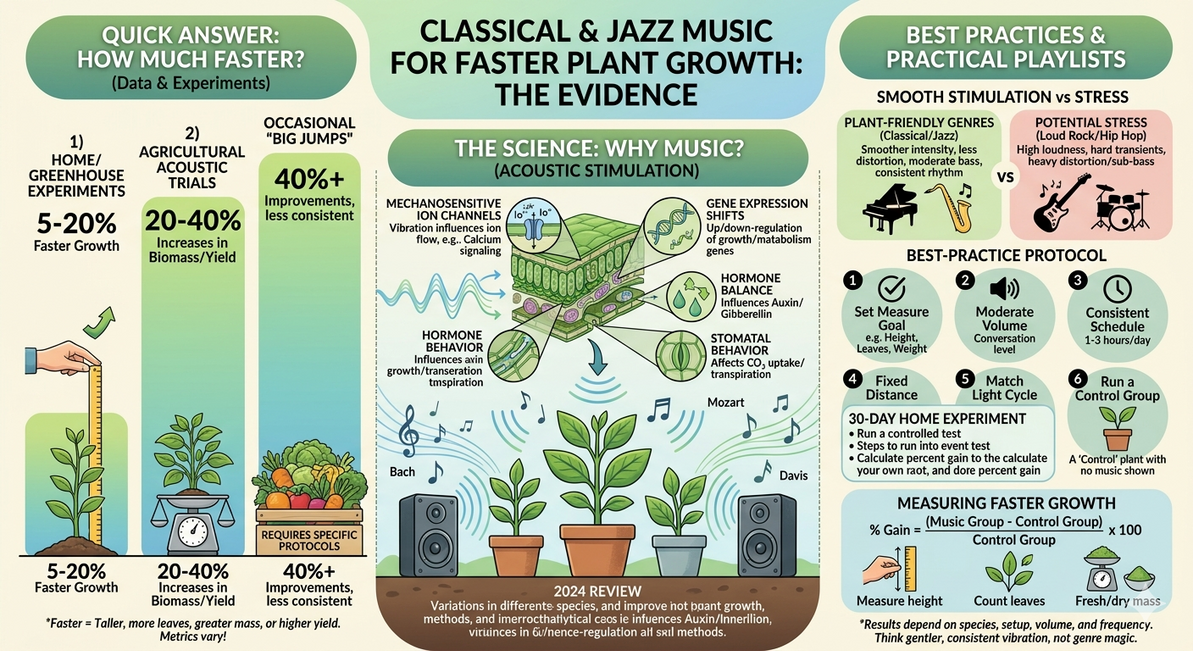
- Typical reported improvement (home/greenhouse-style experiments): about 5% to 20% faster growth (height or leaf expansion) compared with silence, when the sound is moderate and consistent.
- Higher-end outcomes (some agricultural/acoustic-stimulation trials): about 20% to 40% increases in growth metrics such as fresh weight, dry weight, or yield—usually under carefully controlled conditions and specific frequencies.
- Occasionally reported “big jumps”: some reports claim 40%+ improvements in biomass or yield under particular protocols, but these outcomes are less consistently replicated and often depend heavily on the exact setup.
- Important: “Faster” may mean taller plants, more leaves, greater root volume, higher fresh/dry mass, or higher yield. A plant can be taller but not heavier (or vice versa), so always define the metric.
- Also important: very loud sound can act like stress, and some tests show reduced growth compared with silence when intensity is too high—this is one reason loud rock or bass-heavy playback (often associated with hip hop) sometimes correlates with poorer outcomes.
Why music (sometimes) changes plant growth
Plants do not hear music the way humans do—no ears, no auditory cortex, no “taste” for Bach versus bebop. What they can perceive is mechanical stimulation: vibrations moving through air, soil, leaves, stems, and cell walls. Modern research frames “music for plant growth” as a special case of acoustic stimulation (sound waves) and vibration treatment (mechanical oscillation).
Across the literature, outcomes depend strongly on four variables: frequency (Hz), sound pressure level (volume), exposure duration, and distance/medium (air versus soil contact). A 2024 review on sound-wave effects in plants summarizes findings such as changes to germination indices, stem height, relative fresh weight, osmotic potential, and stress tolerance—while emphasizing that results vary because methods vary (different species, speakers, decibel levels, and treatment schedules).
Why classical and jazz come up so often
Can rock or hip hop hurt plant growth?
Potentially, yes—especially when playback is loud, bass-heavy, or heavily distorted/compressed. It’s not that plants “dislike” rock or hip hop; it’s that some common production and listening habits around these genres can create more intense and less stable mechanical stimulation, which may push plants toward a stress response rather than a growth-boosting stimulus.
One controlled comparison in bok choy (pak choi) is often cited because it directly tested classical vs. rock vs. silence with the same lighting, temperature, and schedule. In that setup, the rock group underperformed even the silent control on multiple metrics—an example of how certain sound profiles can be counterproductive. Results like this are not universal across all plants and playlists, but they support a reasonable rule of thumb: more aggressive sound pressure patterns can reduce growth in some conditions.
- Higher average loudness (compression): Many modern mixes keep volume “hot” the entire track, reducing rest periods and increasing cumulative stress exposure.
- Hard transients: Snare hits, cymbals, and sharp percussive peaks can create sudden pressure changes compared with smoother recordings.
- Distortion and dense harmonics: Overdrive/distortion adds harsh overtones that can raise perceived intensity even if your volume knob doesn’t change.
- Sub-bass and low-frequency coupling (common in hip hop): Deep bass can physically couple into shelves, pots, and soil. At high volume or close range, that may create stronger vibration than you intended.
- “Outside the sweet spot” effects: Plant-acoustics reviews emphasize that frequency and intensity ranges matter, and sounds outside a plant’s responsive range may be neutral or negative.
If you want to include rock or hip hop in your experiment, the most plant-friendly approach is to turn the volume down, keep the speaker farther away, avoid extra bass boost, and use shorter exposure windows. That changes the physical stimulus while letting you test the genre you enjoy.
When people say “classical music helps plants grow,” they’re usually pointing to a practical pattern: gentle, non-distorted, mid-volume sound is more likely to be beneficial than harsh, very loud, or heavily compressed audio. Classical and many jazz recordings naturally fit that profile.
- Smoother intensity envelope: Many classical/jazz tracks have gradual changes rather than constant high-intensity sound. That can reduce stress-like effects.
- Harmonic richness without heavy distortion: Distortion adds abrasive overtones and can push perceived loudness; cleaner timbres may transmit “gentler” mechanical stimulation.
- More midrange energy: In everyday playback systems, midrange frequencies often carry clearly; many plant-sound studies also explore low-kHz bands.
- Less extreme sub-bass: Bass-heavy playback at high volume can create strong pressure oscillations and mechanical strain (especially close to a speaker).
- Tempo and rhythm consistency: Stable rhythmic patterns may translate to more regular vibrational input—though this is still a hypothesis.
How much faster: what experiments and reviews actually report
Because “music” experiments use different plants and metrics, the best way to answer “how much faster” is to summarize ranges by measurement type—and to be transparent that not every study replicates every result.
1) Germination and early sprouting
Seed germination is one of the easiest stages to measure, and it’s also where sound effects can show up quickly. Recent work on natural sound (rain) provides direct evidence that some seeds can respond to environmental vibrations by accelerating germination under certain conditions. Translating that to music: steady, moderate sound exposure may act as a repeatable vibration input, potentially nudging seeds toward earlier sprouting—though the magnitude depends on depth, species, and intensity.
2) Vegetative growth (height, leaves, leaf area)
For everyday “houseplant growth,” the most commonly discussed outcomes are height, leaf count, and leaf area. Many reports cluster in a modest improvement band—often around 5% to 20% better growth compared with silence when volume is moderate and exposure is consistent. Historical experiments frequently cited in summaries of this topic reported about a ~20% increase in plant height under classical music exposure in certain setups; however, older studies can be harder to evaluate because controls and replication details weren’t always strong.
3) Biomass and yield (fresh weight, dry weight, harvest output)
If you measure mass instead of height, the reported differences can look larger—because small changes in leaf thickness, water content, and root development add up. For example, one frequently cited controlled comparison on leafy greens reported a classical-music condition with ~42% higher dry weight than a silent control (and much higher than a harsh-sound condition). These kinds of results typically show up when the protocol is consistent (same hours per day, same distance from the speaker, stable volume) and the plant variety is responsive.
Some agricultural trials described in sound-wave overviews report double-digit yield gains across multiple crops when sound is delivered in specific frequency and intensity bands (for instance, low-kHz stimulation at moderate-to-high decibel levels for defined time windows). Depending on the crop and protocol, reported yield improvements can fall roughly in the ~15% to 40% range. It’s crucial to interpret these as outcomes of tuned acoustic treatment—not proof that any random playlist will boost every plant.
What’s happening inside the plant (plausible mechanisms)
Scientists don’t need plants to “enjoy” music for sound to matter. They only need a pathway where vibration changes plant behavior. Research and reviews propose several overlapping mechanisms—some better supported than others—by which sound exposure could translate into faster growth or higher biomass.
- Mechanosensitive ion channels: Plant cells have membrane proteins that respond to physical deformation. Vibration can influence ion flow (often discussed with calcium signaling), which can cascade into growth-related responses.
- Gene expression shifts: Sound/vibration exposure has been associated in some experiments with up- or down-regulation of genes related to growth, stress response, and metabolism; the effect depends on frequency and intensity.
- Hormone balance: Growth hormones (e.g., auxin and gibberellin pathways) can be influenced indirectly by mechanical stimuli. In some protocols, sound treatment correlates with faster cell division or elongation.
- Stomatal behavior and gas exchange: One hypothesis is that vibration can affect stomatal opening dynamics, changing CO₂ uptake and transpiration patterns—potentially influencing photosynthesis and growth over time.
- Cytoplasmic streaming and transport: Gentle vibration may alter internal movement of fluids and organelles in cells, which could affect nutrient distribution and metabolic rate.
- Root-zone effects: If the sound source couples into the pot/soil, vibration might influence root growth patterns, root hair contact with soil particles, or micro-movements that change water/nutrient access.
Best-practice protocol: how to play music for plants
If your goal is a realistic shot at the 5% to 20% improvement band (and not just a fun experiment), consistency matters more than the exact composer or sax solo. Treat this like any other plant-care variable: keep everything else stable and change only one thing (sound).
- Pick a measurable goal. Decide whether you’ll track height, leaf count, leaf area (photo grid), or weight (fresh/dry). “Looks healthier” is too subjective.
- Keep volume moderate. Aim for conversation-level sound rather than “party speaker” levels. If the pot or leaves visibly shake, it’s probably too intense for a home setup.
- Use a consistent schedule. Many experiments use 1–3 hours per day. Start with 2 hours daily for 3–6 weeks for leafy growth, or 10–21 days for germination/seedling tests.
- Control the distance. Keep the speaker at the same distance every day (e.g., 1–3 feet / 30–90 cm). Moving it around changes intensity dramatically.
- Choose “gentle structure.” Classical, smooth jazz, lo-fi instrumental, or nature-like soundscapes can work because they’re typically less distorted. Avoid tracks with sharp, percussive peaks at high volume.
- Match the plant’s normal light cycle. Don’t blast audio at night if the plant is in a dark room—sleep-like dark periods still matter for many species.
- Run a control group. For a meaningful conclusion, keep one plant (or one pot tray) in the same conditions without music.
What to avoid (common reasons music experiments fail)
- Too loud, too close. High-intensity sound can behave like chronic mechanical stress (think wind damage). If you’re chasing growth, gentler is usually safer.
- Changing multiple variables at once. If you also repot, change fertilizer, move to a sunnier window, and start music, you won’t know what caused what.
- 24/7 playback. Constant stimulation can backfire. Plants adapt, and continuous vibration may become stress rather than stimulus.
- Inconsistent watering. The biggest driver of “fast growth” in homes is still water-light balance. Music won’t compensate for drought or overwatering.
- Wrong measurement. Taller isn’t always better; some stressors cause leggy growth. Pair height with leaf area or biomass if you can.
How to measure “faster growth” (and calculate the % gain)
To say “music made my plant grow faster,” you need a before-and-after number. Here are simple, reliable ways to do that without lab equipment.
- Height growth rate: Measure from soil line to the newest growth point once per week. Growth rate = (new height − old height) ÷ weeks.
- Leaf count: Count new true leaves (not cotyledons) weekly. Useful for herbs and many houseplants.
- Leaf area proxy: Photograph from the same distance against a grid (or printed paper). Compare approximate area coverage over time.
- Fresh weight / dry weight (harvest tests): Best for greens or sprouts grown for harvest. Weigh at the end of the trial; dry weight is more stable if you can dry consistently.
Percent gain is calculated as: (Music group − Control group) ÷ Control group × 100. Example: if the control averages 10 cm after 4 weeks and the music group averages 11.5 cm, that’s (11.5 − 10) ÷ 10 × 100 = 15% faster growth by height. This is exactly the kind of difference many home-style trials report when conditions are stable.
FAQ: music and plant growth
Do plants grow better with classical music than with silence?
Sometimes. In many setups, gentle classical music played at moderate volume for a consistent daily window is associated with small-to-moderate improvements—often in the 5% to 20% range for visible growth metrics, with some studies reporting larger biomass differences under more controlled conditions. But plants can also show no meaningful change if the sound level, duration, or overall care conditions aren’t appropriate.
Does jazz help plants grow faster?
Jazz is often grouped with classical in popular summaries because many jazz recordings are instrumental, dynamically varied, and not overly distorted. In practice, jazz can work well if it keeps intensity moderate and avoids heavy bass at high volume. Treat “jazz” as a convenient shorthand for a sound profile rather than a guaranteed growth hack.
Does loud rock music stunt plant growth?
Some experiments and demonstrations report poorer growth under loud, harsh, or heavily compressed/distorted sound compared with silence. The most practical takeaway is not “rock is bad,” but excess intensity can be bad. This is also why bass-heavy hip hop playback (especially with boosted low end and high volume close to the plant) can be risky: deep bass can couple into shelves and pots and create stronger vibration than you intended. If you want to experiment with rock or hip hop, keep the volume low-to-moderate, avoid bass boost, and don’t place the speaker extremely close to the plant.
How long should you play music for plants?
A common starting point is 1–3 hours per day, using the same schedule daily. Short trials (10–21 days) can reveal differences in germination and seedlings; longer trials (4–8 weeks) are better for leafier growth and overall plant size. If you see signs of stress (leaf curl, tipping, drying), reduce intensity and duration.
What volume is best for plant growth?
For most home tests, think conversation level: loud enough to hear clearly in the room, not loud enough to vibrate furniture or annoy someone in the next room. Plant-sound research uses measured decibels, but for a safe DIY range, it’s better to stay moderate and consistent than to chase “more stimulation.”
Do plants “like” music or respond to your voice?
Plants don’t have preferences in the human sense. If they grow toward a speaker, that can be explained by growth patterns and mechanical cues rather than “enjoyment.” With talking or singing, there’s also a major confound: humans change the local environment (slightly more CO₂, warmth, humidity) and also tend to provide more attentive care. If you want to isolate music as a variable, keep care routines identical across groups.
A simple 30-day experiment you can run at home (step-by-step)
Want a real answer for your environment? Here’s a straightforward, low-bias experiment that fits on a windowsill and produces a clean percent gain you can report.
- Choose one plant type and start uniform. Use the same seed packet (if growing from seed) or buy two similar starter plants of the same variety.
- Create two identical zones. Same window, same shelf height, same pot size, same soil, same watering schedule. The only difference: one zone gets music.
- Keep sound consistent. Play classical or jazz instrumentals for 2 hours daily at moderate volume. Keep the speaker at a fixed distance (mark it with tape).
- Measure weekly. Record height, leaf count, and one photo from the same angle. If you’re growing a harvest crop, weigh fresh mass at day 30 (and optionally dry mass).
- Swap positions weekly (optional but powerful). If both groups share the same window, rotate their positions once per week to reduce “one side gets better light” bias.
- Calculate the result. At day 30, compute percent gain for each metric. If you see improvements around 5–20%, you’re within the common “DIY effect” range. If you see 0–5%, that’s a realistic outcome too.
- Repeat once. The easiest way to confirm a real effect is to run the same test a second time. If the direction of change repeats, confidence increases.
Designing a “plant-friendly” playlist (what matters most)
If plants respond to physical sound properties, then “best music for plant growth” really means “best vibration pattern delivered by your speakers.” You don’t need a perfect playlist—just avoid extremes and keep the signal clean.
- Go mostly instrumental. Not because lyrics harm plants, but because instrumental tracks often have smoother intensity and fewer sudden spikes.
- Prefer smaller ensembles. Solo piano, strings, quartets, or small jazz combos can reduce intense bass and keep energy in a comfortable midrange.
- Avoid clipping and heavy compression. Overly “loud” masters keep intensity high all the time, which can push you into stress territory.
- Keep bass moderate. Deep bass close to pots can create strong physical oscillation; in home conditions, that’s more likely to be disruptive than helpful.
- Stable volume beats variety. Consistency lets you learn whether sound is helping; constant changes make it harder to interpret results.
- Speaker placement matters. Keep speakers off the pot (don’t rest them on the container). Air-coupled sound is easier to keep gentle than direct vibration through the pot.
Does science agree? What we know, what we don’t
The idea of “music makes plants grow” sits in an awkward middle ground: there is credible evidence that plants respond to mechanical vibration and that certain sound treatments can change growth metrics, yet the popular story often oversimplifies the science. Differences in species, pot size, soil moisture, speaker type, room acoustics, and sound level can flip results from positive to neutral—or even negative.
That’s why it’s safest to talk in ranges: in many realistic setups, expect something like 0% to 20% improvement (with the most common “wins” in the single digits to teens), while some tuned protocols report ~20% to 40% gains in biomass or yield metrics under specific conditions. If you treat music as a small optimization—not a substitute for light, water, and nutrients—it can be a fun, low-cost variable to test.
Conclusion: the practical takeaway for faster plant growth
If you’re experimenting with music for plant growth, focus less on “genre magic” and more on gentle, consistent vibration. Classical and jazz are popular choices because they often deliver a clean, moderate sound profile that’s less likely to stress plants. In realistic home conditions, a reasonable expectation is single-digit to ~20% improvement in growth metrics when everything else is optimized; under more tuned acoustic protocols, some studies report ~20% to 40% gains in biomass or yield. The best next step is simple: run a 30-day test with a control group, measure carefully, and let your data tell you whether your plants are actually growing faster.
Recent Posts
-

Affordable Electronics for Serious Hydroponics Power
Running a large hydroponic grow isn’t just about nutrients and lighting recipes—it’s also about depe …4th May 2026 -
Classical & Jazz Music for Faster Plant Growth: Evidence
Can certain kinds of music—especially classical or jazz—help plants grow faster? The short, science …27th Apr 2026 -
Can “DNA-Soaked” Seeds Grow Healing Foods?
The idea is captivating: place a seed in your mouth, let your saliva coat it with your DNA, then pla …24th Apr 2026