
Can “DNA-Soaked” Seeds Grow Healing Foods?
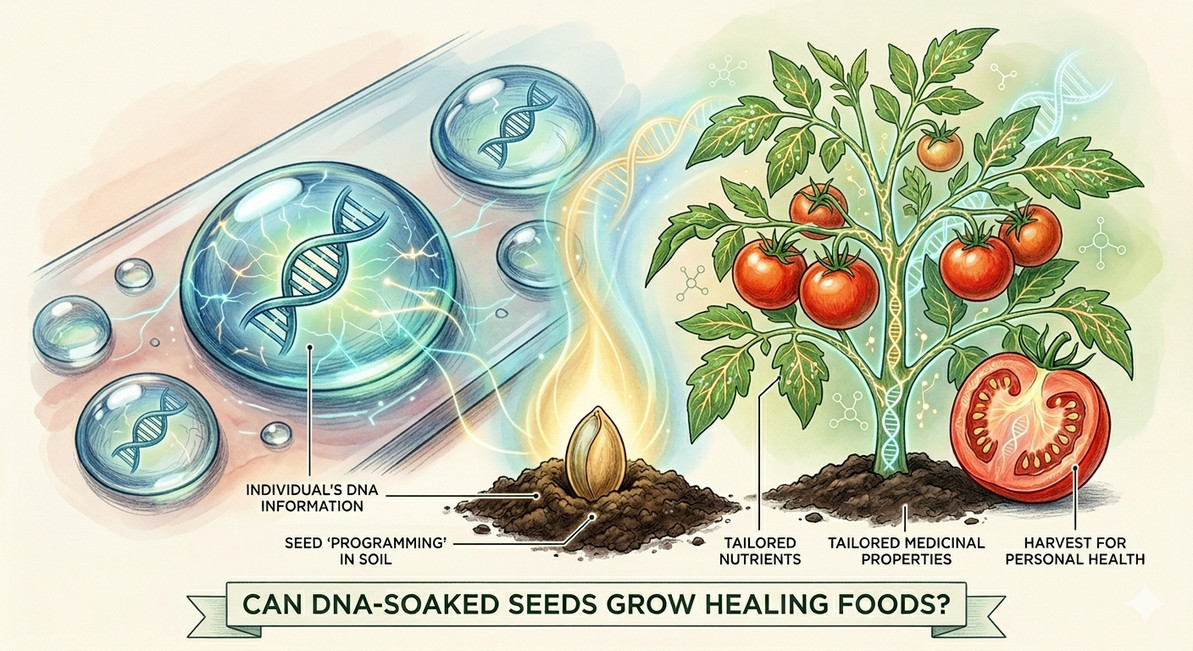
The idea is captivating: place a seed in your mouth, let your saliva coat it with your DNA, then plant it and harvest fruits or vegetables “designed” to heal your specific health problems. It promises personalization, nature-based medicine, and a kind of biological intimacy—your body informing a plant how to take care of you.
However, as appealing as this sounds, it conflicts with what we know about genetics, plant development, and how DNA functions. A seed doesn’t “read” human DNA on its surface the way a computer reads a file, and a plant can’t reorganize its biology to produce a custom medicine just because it contacted your saliva.
This article explains why the saliva-and-DNA seed claim is not supported by biology, what parts of the story resemble real science (such as plant breeding, genetic engineering, and personalized nutrition), and what evidence-based paths actually exist for using food and plants to support health. It’s educational information, not medical advice; if you have health problems, use qualified medical guidance and proven treatments.
The Claim: “Imprint Your DNA” to Grow a Healing Crop
Versions of this claim circulate in wellness communities and social media: you hold a seed in your mouth for a minute or two, letting saliva—sometimes described as carrying “your DNA information”—coat the seed. The seed is then planted, and the resulting fruit or vegetable is said to become uniquely compatible with your body, capable of correcting deficiencies, reducing inflammation, balancing hormones, or addressing whatever problem you’re experiencing.
It feels plausible because it borrows the language of real biology: DNA, signaling, adaptation, and the well-established fact that plants make pharmacologically active compounds. But plausibility in storytelling is not the same as plausibility in molecular genetics. To see why, it helps to start with what a seed is and what saliva contains.
What’s Actually in a Seed—and in Your Saliva
A seed is a living plant embryo packaged with stored energy and protected by a seed coat. Inside are the plant’s own chromosomes—its genetic instructions—already set at the time the seed formed on the parent plant. When the seed germinates, cells divide and specialize according to that pre-existing plant genome plus environmental cues like temperature, water, light, nutrients, and stress.
The seed coat is not just a shell; it’s a barrier that protects the embryo from pathogens, mechanical damage, and random molecules in the environment. While seeds can absorb water (and sometimes small dissolved molecules) during imbibition, the passive uptake of intact, functional DNA from a human mouth is not a normal route for rewriting a plant’s genome.
Saliva is mostly water plus enzymes, proteins, electrolytes, and microbes. It can contain small amounts of human DNA—usually from shed cheek cells and white blood cells—and fragments of DNA from bacteria and food. But “having DNA present” is very different from “providing usable genetic instructions to a different organism.” DNA outside cells is rapidly degraded by enzymes (including nucleases), microbes, and environmental factors. Even if fragments remain on a seed coat, they are not automatically imported into the embryo’s cells, copied, and expressed.
How Genes Move (and Why Mouth Contact Doesn’t Do It)
For a plant to acquire new genetic information, several unlikely steps must happen in sequence: DNA must enter a living plant cell (not just sit on the outside), reach the nucleus (or chloroplast/mitochondrion), integrate into the genome or persist as a stable genetic element, avoid being destroyed, and then be expressed in the right tissues at the right times. Finally, the change must influence traits such as nutrient composition, metabolite production, or disease resistance.
Nature does have a phenomenon called horizontal gene transfer—genes moving between organisms outside of normal reproduction. But in plants it is relatively rare and typically involves special mechanisms (for example, certain bacteria that can transfer DNA into plant cells, or gene movement over evolutionary time scales). It is not something that happens reliably from casual contact with human saliva.
In laboratories, plant genetic modification is possible, but it requires deliberate techniques: using Agrobacterium to deliver a designed DNA construct, “gene gun” biolistics to shoot DNA-coated particles into cells, or direct editing systems like CRISPR delivered via specialized vectors. Even then, researchers select transformed cells, regenerate whole plants from tissue culture, and verify changes with sequencing and expression assays. None of that resembles a seed briefly coated in saliva.
Why a Plant Can’t “Design” a Cure for Your Specific Condition
Even if, hypothetically, a plant could take up and use foreign DNA from the environment (again, mouth contact won’t do this), the idea that it could interpret your personal genetic variation and then tailor a precise therapeutic profile is a leap across multiple scientific gaps.
- Most health problems aren’t encoded as a single “DNA message.” Conditions like diabetes, autoimmune disorders, depression, or chronic pain involve complex pathways, environment, lifestyle, microbiome, and often multiple genes. A plant would need a “translation layer” that doesn’t exist.
- Human DNA isn’t an instruction manual for plants. The majority of human DNA sequences have no function in plants, and even conserved genes operate in very different cellular contexts.
- Therapeutic molecules are specific. A compound that helps one problem can worsen another, and safe dosing matters. “Personalized medicine” requires diagnosis, targets, and controlled amounts—things agriculture can’t infer from a saliva coating.
- Plants don’t have intent or diagnostic capability. Plants respond to water, light, nutrients, pathogens, and stress signals. They do not diagnose a human mouth microbiome or read a person’s symptoms.
People who try practices like this may still report benefits. That can happen for many reasons: improved diet from eating more produce, better hydration and routine, increased attention to health, or placebo effects (real changes in perception and sometimes physiology driven by expectation). Those outcomes are worth respecting—but they don’t validate the DNA-imprinting mechanism.
What’s Real Science Nearby: Food Tailored to Health
1) Selective breeding and modern genomics
Humans have been “designing” crops for millennia—just not by saliva. Farmers saved seeds from plants with desirable traits: better taste, higher yield, drought tolerance, fewer toxins, or improved storage. Today, plant breeders use genetic markers and sequencing to track traits faster and more precisely, but the core mechanism is still inheritance through plant reproduction.
This can influence health indirectly. For example, breeders can select for higher fiber, higher carotenoids, different fatty-acid profiles, or lower levels of certain bitter compounds. But the selection is population-based: it targets traits that help many people, not a single individual’s DNA signature.
2) Biofortification (nutrients bred or engineered into crops)
Biofortification aims to increase specific nutrients in staple foods—vitamin A precursors, iron, zinc, folate—so that populations are less likely to develop deficiency-related disease. This is done through selective breeding, agronomy (fertilizer strategies), or genetic engineering depending on the crop and region.
Biofortified foods aren’t “custom coded” to your genome, but they are a genuine example of agriculture aligned with health outcomes: change the crop’s composition in a measurable way, then evaluate whether it improves biomarkers or deficiency rates.
3) Growing conditions that change plant chemistry
Plants adjust their chemistry based on their environment. Light spectrum can influence pigments like anthocyanins; mild stress can change antioxidant profiles; soil minerals affect micronutrient uptake; and harvest timing matters for sugar and acid levels. Controlled-environment agriculture (greenhouses, vertical farms) can tune some of these variables more consistently than open fields.
If you want produce that better supports your health goals, manipulating growing conditions is far more realistic than “DNA imprinting.” For example, someone trying to increase dietary antioxidants may focus on deeply colored berries and greens and on varieties known to be rich in those compounds, rather than expecting a seed to self-program around a diagnosis.
4) Plants as biofactories for medicines
There is also a legitimate field sometimes called molecular farming: using plants to produce pharmaceuticals or vaccine components. In these systems, scientists introduce a specific genetic construct into plant cells (often temporarily, sometimes stably), then harvest and purify the target protein. This is carefully designed, tested, and regulated, because medicines must be consistent, safe, and effective.
This is the closest real-world analogue to “plants producing healing compounds,” but it’s still not personalized to one person’s saliva. It’s the opposite: standardized manufacturing under controls.
Risks and Red Flags
Putting a seed in your mouth is unlikely to create a “healing crop,” but it can still introduce problems—especially if the claim leads someone to replace effective care or to mishandle seeds and soil.
- Delayed diagnosis or treatment. If someone relies on a ritual to address serious symptoms, they may postpone medical evaluation.
- Contamination. Saliva introduces microbes. For most garden plants this is not dramatic, but it can add pathogens to the seed surface and to the immediate soil environment, and it’s an avoidable hygiene issue.
- Seed viability. Soaking and handling seeds improperly can reduce germination or encourage mold.
- Misinformation patterns. Claims that use scientific-sounding terms (DNA, frequency, “imprinting”) without a testable mechanism are a common sign of pseudoscience.
Evidence-Based Ways to Use Food to Support Health
If your goal is to eat in a way that better matches your body, there are grounded approaches that keep the spirit of personalization—without magical biology.
- Start with a clear goal and a clinician’s input when needed. “More energy” might mean sleep, iron status, thyroid function, depression screening, or diet quality. If symptoms are persistent or severe, get evaluated.
- Use proven nutrition patterns. Many health outcomes improve with patterns rich in vegetables, legumes, fruits, whole grains, and unsaturated fats, and lower in ultra-processed foods. The exact pattern depends on allergies, preferences, culture, and medical needs.
- Choose crops/varieties that match your goal. For example, prioritize fiber-forward foods (beans, oats, berries, crucifers) for gut and cardiometabolic support, or potassium-rich produce (leafy greens, beans, squash) if your clinician recommends it.
- Grow what you will reliably eat. The biggest “personalization” win is adherence. If you love tomatoes and herbs, you’ll eat them often; frequency matters more than mystical customization.
- Optimize growing conditions safely. Good soil, appropriate fertilizer, adequate sunlight, and safe composting can improve yield and quality. If you’re concerned about contaminants, consider soil testing and safe gardening practices.
A Quick Checklist for “Biohacking” Claims Like This
- Is there a testable mechanism? Can someone explain, step by step, how DNA gets into the plant’s cells and changes traits?
- Is there published evidence? Not testimonials—controlled studies with measurable outcomes.
- Are there clear boundaries? Real science states limitations, risks, and what it does not do.
- Does it replace standard care? Be wary if the claim encourages avoiding doctors, diagnostics, or proven treatments.
- Can the effect be reproduced? If each person gets a different result with no measurement, it’s often belief-driven rather than biology-driven.
Conclusion
Coating a seed with saliva may feel like a powerful act of connection—your body and a future harvest linked by intention. But intention is not a molecular delivery system. The biology required for a seed to absorb, integrate, and act on human DNA is far beyond what happens in a brief mouth contact, and the notion of a plant tailoring its fruit to your personal health problems has no credible scientific support.
The good news is that the broader dream—food that supports health—is real, just in a different form: evidence-based nutrition, thoughtful gardening, breeding and biofortification, and carefully regulated plant biotechnology. If you want “personalized” produce, the most reliable path is to grow and choose foods aligned with your needs and to pair that with appropriate medical care, not to expect DNA on the outside of a seed to rewrite what grows on the inside.
Recent Posts
-

Affordable Electronics for Serious Hydroponics Power
Running a large hydroponic grow isn’t just about nutrients and lighting recipes—it’s also about depe …4th May 2026 -
Classical & Jazz Music for Faster Plant Growth: Evidence
Can certain kinds of music—especially classical or jazz—help plants grow faster? The short, science …27th Apr 2026 -
Can “DNA-Soaked” Seeds Grow Healing Foods?
The idea is captivating: place a seed in your mouth, let your saliva coat it with your DNA, then pla …24th Apr 2026