
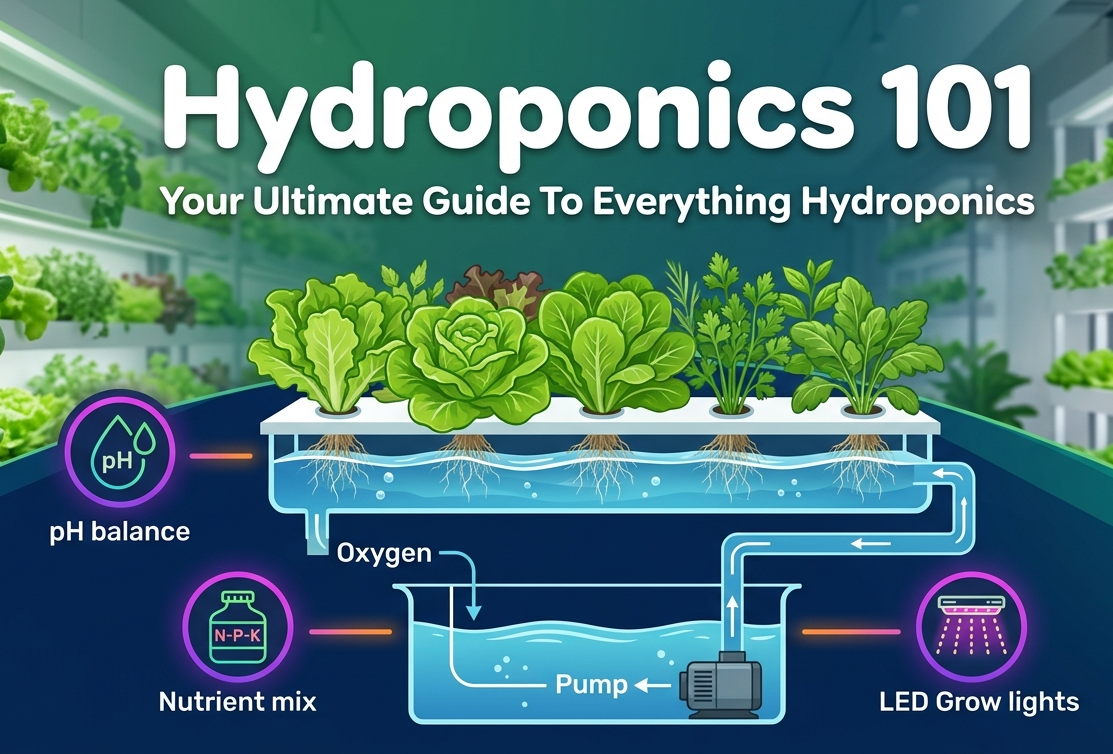
Hydroponics 101 - Your Ultimate Guide To Everything Hydroponics
Introduction
Hydroponics is a method of growing plants without soil by delivering water, oxygen, and nutrients directly to the roots. Done well, it can produce clean, flavorful greens, herbs, and vegetables in small indoor spaces—often with faster growth and fewer pests than traditional gardening.
This book is written for total beginners. You’ll learn how to choose a growing space, select a simple system, set up lights and ventilation, mix nutrients, start seeds, maintain healthy root zones, and troubleshoot common problems. The guidance here focuses on legal, edible crops (vegetables and culinary herbs) and emphasizes safe, responsible indoor growing practices.
Quick Start: Your First 30 Days (Overview)
- Day 1–2: Pick a grow location (stable temperature, access to power/water, easy to clean).
- Day 3–5: Choose a beginner system (Kratky for leafy greens, small DWC, or a simple drip setup).
- Week 1: Buy or assemble core gear: reservoir/bin, net pots, media, air pump (if needed), nutrients, pH test kit, and a basic LED grow light.
- Week 1–2: Germinate seeds; keep seedlings warm and evenly moist.
- Week 2: Mix nutrients at a mild strength; adjust pH into your crop’s target range.
- Week 2–4: Transplant seedlings; set light height and schedule; keep airflow moving.
- Week 3–4: Start routine maintenance: top up water, check pH/EC, inspect roots/leaves, clean spills.
- Week 4+: Harvest cut-and-come-again greens; refine your process and scale up.
Book Roadmap (Chapters at a Glance)
Expanded Contents (Chapters + Appendices)
- Chapters 1–7 follow the roadmap above.
- Chapter 8: Nutrients & Water Chemistry (Made Simple) — Water quality; mixing nutrients; pH/EC targets; reservoirs and top-offs; preventing lockout.
- Chapter 9: Seedlings to Harvest (Step-by-Step) — Germination stations; transplanting; vegetative growth routines; harvest and regrowth; basic pruning and support.
- Chapter 10: Cleanliness, Food Safety & System Sanitation — Algae prevention; safe cleaning; between-crop reset; handling and storing harvests.
- Chapter 11: Scaling Up at Home — Adding more sites; backup power basics; automation options; keeping consistent results.
- Chapter 12: Planning, Budgeting & Recordkeeping — What to buy first; cost ranges; tracking pH/EC; crop planning; yield expectations.
- Appendix A: Shopping Lists (By Budget)
- Appendix B: Nutrient Mixing & Reservoir Cheat Sheets
- Appendix C: pH + EC Logs (Printable Templates)
- Appendix D: Crop Profiles (Leafy Greens, Herbs, Fruiting Plants)
- Appendix E: Troubleshooting Quick Reference (Symptoms → Causes → Fixes)
- Appendix F: Sanitation SOP (Between Runs)
- Appendix G: Glossary of Hydroponics Terms
- Chapter 1: A Beginner’s Guide — The right growing location; choosing the right method; lighting; testing equipment; proper ventilation.
- Chapter 2: Introduction to Hydroponic Systems — What hydroponics is; pros and cons; how systems work; simple schematics; environmental and nutritional requirements; selecting and setting up an indoor grow space.
- Chapter 3: Types of Hydroponic Systems — Passive vs. active; common active system types; how to build your own system; lighting requirements; maintenance routines.
- Chapter 4: Which Vegetables to Grow Indoors for Success — A practical crop list; seed selection; germination; plant combinations.
- Chapter 5: Growing Vegetables and Herbs Hydroponically — Constructing a drip-feed system; maintaining it; growing herbs; notes for commercial herb production.
- Chapter 6: Troubleshooting — pH issues; pests; water problems; nutrient overuse; light distance; root binding; algae; mold; fungus.
- Chapter 7: Going Commercial — Key requirements; cultivating herbs for commercial use.
Chapter 1: A Beginner’s Guide
Hydroponics can be as simple or as technical as you want it to be. The goal of this chapter is to help you make a handful of “big” decisions correctly—where you’ll grow, what style of system you’ll start with, and how you’ll control light, air, and water quality. If you get these fundamentals right, most of the smaller details become easy.
Beginner Baseline: What You Need (Minimum)
- A clean container/reservoir (food-safe tote or bucket) with a lid to reduce light leaks.
- A way to hold plants: net pots plus a medium (rockwool, coco/perlite, clay pebbles, etc.).
- Hydroponic nutrients designed for vegetables/herbs (not generic fertilizer spikes).
- pH testing (drops or meter) and pH adjusters (pH Down and pH Up).
- Light (sunlight can work for some setups; indoor success usually needs an LED grow light).
- Air movement (a small oscillating fan) and basic cleanliness supplies.
- Optional but helpful: EC/TDS meter, thermometer, hygrometer, timer, and an air pump/stone for DWC.
The Right Growing Location
Your grow location matters more than most beginners expect. Hydroponics is basically controlled plant care: you’re controlling light, temperature, airflow, and water chemistry. The best “hydroponic room” is one that makes those controls easy—not one that looks impressive.
Location Checklist
- Stable temperature: Most leafy greens and herbs prefer typical indoor temperatures. Avoid spaces that swing hot/cold (garages, attics, sunrooms without climate control).
- Access to power: Lights, fans, and pumps need safe outlets. Use drip loops on cords and keep power strips off the floor.
- Access to water: You’ll be topping up reservoirs and occasionally dumping/refilling. A nearby sink or drain makes life easier.
- Easy to clean: Choose a space where a small spill won’t ruin flooring and where you can wipe surfaces regularly.
- Light control: If you are using grow lights, you’ll want to control when the area is dark (especially for fruiting plants). A closet, tent, or dedicated corner is ideal.
- Airflow potential: You need moving air around leaves and, often, a way to vent warm air out of the space.
- Noise tolerance: Air pumps and fans hum. Pick a location where that won’t be a daily annoyance.
- Pet/child safety: Keep nutrients, tools, and electrical components out of reach.
Common Indoor Grow Locations (Pros and Cons)
- Grow tent: Great light control and cleanliness; easier to manage humidity and pests; adds cost but reduces headaches.
- Closet: Convenient and discreet; can trap heat/humidity without ventilation; watch for moisture damage.
- Spare room corner: Comfortable to work in and easy access; may spill light into the room unless you use curtains/tent.
- Basement: Often cool and stable; may be humid (risk of mold) and may need dehumidification and better lighting.
- Garage: Usually not ideal for beginners due to temperature swings and pests, unless climate-controlled and clean.
Choosing the Right Hydroponic Method of Growing
There isn’t one “best” hydroponic system. The right choice depends on what you want to grow, how hands-on you want to be, and how comfortable you are with pumps and plumbing. As a beginner, the best system is the one you can keep clean and maintain consistently.
Three Beginner-Friendly Starting Points
- Kratky (passive “no pump” method): Excellent for lettuce, leafy greens, and many herbs. Low cost and quiet. Best for smaller plants and shorter cycles.
- Deep Water Culture (DWC): Roots sit in an aerated nutrient solution. Great growth for greens and herbs. Requires an air pump/stone and regular checks.
- Simple drip system: Nutrient solution drips through media to roots and returns to a reservoir (or drains away). Flexible for herbs and some fruiting plants. More parts to manage, but scalable.
Quick Decision Questions
- Do you want the simplest possible setup? Start with Kratky for greens.
- Do you want faster growth and don’t mind a small pump? Start with DWC.
- Do you want to grow in pots/media (more like “normal” gardening)? Start with a drip system.
- Do you travel often? Favor systems with larger reservoirs and fewer failure points (Kratky or a very simple drip with overflow protection).
- Do you want fruiting plants soon (tomatoes/peppers)? Plan for stronger light, sturdier support, and more maintenance—many beginners do better starting with greens first, then upgrading.
Lighting
Light is the “fuel” that powers growth. Indoors, most hydroponic failures trace back to lighting that is too weak, too far away, on for the wrong number of hours, or paired with a space that overheats. You don’t need to become a lighting engineer, but you do need a few basics.
The Three Lighting Controls You Actually Use
- Brightness (intensity): Brighter light generally means faster growth—up to the plant’s limit. Too dim leads to stretched, weak plants.
- Distance from the canopy: Moving a light closer increases usable intensity dramatically. Many “not enough light” problems are really “light too far away.”
- Hours per day (photoperiod): Many leafy greens do well around 14–16 hours of light daily. Fruiting plants may need high intensity plus consistent day/night cycles.
Beginner Rules of Thumb
- Use a timer so plants get the same light schedule every day.
- Start with the light higher, then gradually lower it over a week while watching for stress.
- If seedlings stretch tall and fall over, you likely need more light intensity or closer light distance.
- If leaf edges bleach, curl upward, or develop crispy spots, reduce intensity by raising the light or shortening the day slightly.
- Keep leaves gently moving with a fan; stronger light increases water use, so airflow and reservoir checks matter more.
Testing Equipment
In soil gardening, the soil buffers many mistakes. In hydroponics, the root zone is whatever is in your reservoir right now. That’s why simple testing is so powerful: it lets you catch problems early instead of guessing.
pH: The One Test Every Grower Should Do
pH controls how easily plants can absorb nutrients. If pH drifts too high or too low, plants can show “deficiency” symptoms even when nutrients are present. Many hydroponic vegetables and herbs do well in a slightly acidic range.
- Common target range: roughly 5.5–6.5 for many vegetables and herbs.
- Leafy greens: often happy around 5.8–6.2.
- Herbs: commonly around 5.8–6.5 (varies by herb).
- Check frequency: daily when learning, then every 2–3 days once your system is stable.
EC/TDS: Measuring Nutrient Strength
EC (electrical conductivity) and TDS (total dissolved solids) are two ways of estimating how concentrated your nutrient solution is. A small handheld meter can help you avoid one of the most common beginner mistakes: feeding too strong, too soon.
- Start mild: Seedlings and newly transplanted plants usually prefer a lighter nutrient mix than mature plants.
- Watch the trend: If EC rises over time, plants are drinking more water than nutrients (solution is getting stronger). If EC falls, plants are taking nutrients faster than water (solution is getting weaker).
- Top-up smart: When EC is high, top up with plain water. When EC is low, top up with nutrient solution.
- Keep notes: Write down pH/EC readings and what you changed. This turns “mystery problems” into simple patterns.
Proper Ventilation
Plants don’t just need light and nutrients—they need fresh air. Indoors, “ventilation” and “air circulation” are related but different: circulation moves air around inside your space, while ventilation replaces stale, humid air with fresh air.
What Good Air Management Does
- Reduces mold and mildew risk by preventing humid, stagnant air around leaves.
- Strengthens stems through gentle movement (plants “exercise” a little).
- Improves transpiration, which helps nutrient flow from roots to leaves.
- Removes heat from lights and prevents hot spots.
- Helps manage odors and keeps the grow area comfortable to work in.
A Simple Beginner Setup
- Use a small oscillating fan to create gentle leaf movement—think “breeze,” not “wind.” Avoid blasting seedlings directly.
- If you’re in a tent or closed closet, add an exhaust fan (and a passive intake vent) when you notice heat buildup, persistent high humidity, or slow growth.
- Keep air moving above the canopy and across the plants rather than straight down into the nutrient solution.
- Inspect corners and dense foliage—stagnant zones are where mold often starts.
Chapter 1 Recap
Before you buy more equipment, lock in your grow location and decide on a simple method that fits your goals. Then focus on the “big three” controls: consistent lighting, basic water testing (especially pH), and reliable airflow. In the next chapter, we’ll break down how hydroponic systems work, what parts you actually need, and how to set up your space so it stays clean and easy to manage.
Chapter 2: Introduction to Hydroponic Systems
Now that you’ve chosen a location and understand the “big controls” (light, airflow, and water testing), it’s time to understand what a hydroponic system actually is. The good news: most systems—no matter how complicated they look—are built from the same simple ideas and a small set of parts.
What Is a Hydroponic System?
A hydroponic system is any growing setup where plant roots receive water, oxygen, and nutrients without relying on soil. Instead of roots “searching” through soil for resources, you deliver those resources directly and consistently. This can be done with still water (passive methods), moving water (active methods), or a combination of both.
The Core Parts (Most Systems)
- Reservoir: Holds water + nutrients (your “liquid soil”).
- Plant sites: Net pots, channels, buckets, or containers that support the plant.
- Root zone: Where roots live—air + moisture balance matters here more than anything.
- Delivery method: Still solution, dripping, flowing film, misting, or wicking.
- Aeration: Air stones, waterfall returns, or exposed root zones that provide oxygen.
- Lighting: Sunlight or grow lights that power photosynthesis.
- Environment management: Fans, exhaust, temperature/humidity control, and cleanliness practices.
Pros and Cons of Hydroponic Farming
Pros
- Fast growth and high yields for many crops because water and nutrients are always available.
- Clean produce with less soil mess indoors.
- Efficient water use compared to many soil setups, especially when recirculating.
- Fewer weeds (soil is where weeds usually start).
- More control over nutrients and environment, which can mean more consistent quality.
- Year-round growing regardless of outdoor weather.
Cons
- Less forgiving: Because there’s no soil buffer, problems in pH, temperature, or oxygen can show up quickly.
- Upfront cost: Lights and basic equipment can cost more than a simple outdoor garden.
- Requires monitoring: A small, regular routine (testing and topping up) is part of success.
- Power dependence: Many systems rely on electricity (lights, pumps). You should plan for short outages.
- Sanitation matters: Recirculating water can spread issues if equipment isn’t kept clean.
How Does a Hydroponic System Work?
All hydroponic systems are trying to meet the same five plant needs: light, water, nutrients, oxygen at the roots, and a stable environment. The system’s design determines how those needs are delivered and how much daily attention it requires.
- You mix water and nutrients in a reservoir.
- The solution reaches the roots (still water, drip lines, flowing channels, etc.).
- Roots absorb what they need while also receiving oxygen (from air stones, exposed roots, or draining cycles).
- You monitor and adjust pH/strength, top up water, and keep the system clean.
- You harvest, then reset/clean for the next cycle.
Schematic Representation of a Hydroponic System (Text Diagram)
Light → Plant Leaves → Growth
Reservoir (water + nutrients) → Pump/Gravity/Still Water → Root Zone → (optional) Return/Drain → Reservoir
Oxygen → (air stone / exposed roots / drain cycle) → Healthy roots
Environmental and Nutritional Requirements
You don’t need perfect numbers to succeed—you need stable, reasonable ranges. Beginners do best when they avoid extremes and make small adjustments instead of big swings.
- Air temperature: Comfortable indoor temperatures work for many greens and herbs. Avoid hot, stagnant rooms.
- Humidity: Too high invites mold; too low can stress seedlings. Gentle airflow helps keep leaf surfaces dry.
- Water temperature: Cooler water holds more oxygen. Warm reservoirs increase risk of low oxygen and root problems.
- Oxygen in the root zone: One of the most common hidden failure points. Aerate DWC and avoid suffocating roots in waterlogged media.
- Nutrient balance: Use hydroponic-specific nutrients and follow a mixing routine. Start mild and increase as plants mature.
- pH control: Keep pH in a crop-appropriate range so nutrients stay available.
Selecting a Good Indoor Grow Space and Setting Up
- Define your footprint: Measure the space and decide how many plants you want at one time (start small and succeed first).
- Protect surfaces: Use a waterproof tray/mat under reservoirs. Plan for spills as if they will happen.
- Set your airflow: Place a small fan for circulation. If using a tent/closet, plan intake and exhaust paths.
- Plan cable safety: Keep timers and power strips mounted up and away from water. Create drip loops on cords.
- Place the reservoir: Make it easy to access for testing and top-ups. Avoid direct light on the reservoir to reduce algae.
- Hang/position the light: Center it over your plant area and set a timer schedule that matches your crop.
- Create a “clean zone”: Keep nutrients, measuring tools, and a notebook together so your routine stays consistent.
Chapter 2 Recap
Chapter 3: Types of Hydroponic Systems
Hydroponic systems come in many shapes, but they all solve the same problem: how to keep roots fed, moist, and oxygenated without soil. This chapter explains the main system types in plain language, what they’re best for, and which ones are easiest for beginners to build and maintain.
Passive System
A passive hydroponic system does not rely on pumps to move nutrient solution. Instead, roots access a still reservoir (as in Kratky) or moisture is delivered by capillary action (as in wicking setups). Passive systems are popular with beginners because there are fewer failure points.
Passive Systems: Pros and Cons
- Pros: Simple, quiet, low cost, fewer parts to clean, fewer things to break.
- Cons: Typically best for smaller plants; nutrients can drift as water level drops; warm rooms can reduce oxygen in still water.
- Best beginner crops: Lettuce, arugula, spinach (cooler), basil, cilantro, parsley, mint (watch it spread).
Active System
An active hydroponic system uses one or more pumps to move nutrient solution (and often air) through the root zone. Active systems can scale to more plants and bigger crops, but they require a bit more monitoring and cleaning because moving water can spread issues quickly if something gets out of balance.
Active Systems: Pros and Cons
- Pros: Great growth rates; supports more plants; easier to keep nutrient strength consistent in recirculating designs; adaptable to many crop types.
- Cons: More parts (pump, tubing, timers); power outages matter; leaks/clogs are possible; sanitation is more important.
Types of Active Systems
Deep Water Culture (DWC)
DWC keeps roots in a reservoir of nutrient solution while an air pump and air stone add oxygen. This is one of the best “serious beginner” systems because it’s simple to build, easy to understand, and produces strong growth—especially for leafy greens and herbs.
Nutrient Film Technique (NFT)
NFT runs a thin “film” of nutrient solution down a slightly angled channel so roots can drink while still getting plenty of air. NFT can be very productive for greens, but it’s less forgiving: if the pump fails or a channel clogs, roots can dry out quickly.
Ebb and Flow (Flood and Drain)
Ebb and flow systems periodically flood a tray or container of media with nutrient solution, then drain it back to the reservoir. The flood delivers water and nutrients; the drain pulls fresh air into the root zone. This approach works well for herbs and some larger plants, but it requires a timer, pump, and good overflow planning.
Drip Systems (Recirculating or Drain-to-Waste)
Drip systems deliver nutrient solution to each plant site through small drip emitters. In a recirculating drip system, runoff returns to the reservoir. In a drain-to-waste setup, runoff drains away (often used for precision and disease prevention). For beginners, recirculating drip is affordable and efficient, but it requires more attention to cleanliness and reservoir stability.
Aeroponics (Advanced)
Aeroponics mists roots with nutrient solution while roots hang in air. It can produce excellent growth, but it’s typically not the best first system because misters can clog, pumps must run reliably, and roots can dry out fast if something fails. Consider it a “future upgrade” once you’ve mastered pH, cleanliness, and routine maintenance.
How to Build Your Own Hydroponic System (Beginner Builds)
Build #1: Kratky Tote for Leafy Greens
Materials
- Opaque tote with lid (light-blocking)
- Net pots sized to your lid holes
- Growing medium (for example, clay pebbles or a starter plug + pebbles)
- Hydroponic nutrients
- pH test and pH adjusters
- Drill + hole saw (or a sharp utility method suited to your lid material)
Steps
- Mark plant sites on the lid so plants have room to grow (more spacing is better than crowding).
- Cut holes for net pots. Make sure pots sit securely.
- Mix nutrient solution in the tote at a mild strength appropriate for greens.
- Adjust pH into your target range.
- Place seedlings into net pots with media and set them into the lid.
- At the start, roots should reach moisture. As plants drink, the water level drops and creates an air gap. This is normal and helps oxygenate roots.
- Top up with water as needed and keep the tote covered to block light.
Build #2: Single-Bucket DWC
Materials
- 5-gallon bucket with lid (or a purpose-made DWC bucket kit)
- Net pot that fits the lid
- Air pump, airline tubing, and air stone
- Check valve (prevents backflow during outages)
- Nutrients, pH test, pH adjusters
Steps
- Install airline tubing with a check valve, then connect to the air stone in the bucket.
- Fill with nutrient solution and adjust pH.
- Turn on the air pump. You want steady bubbles, not a violent boil.
- Set the plant in place. Keep the bottom of the net pot moist at first so roots can grow downward.
- Check pH and water level regularly. Aeration helps, but warm water can still reduce oxygen.
Lighting Requirements for Hydroponic Systems
Lighting needs depend on the crop. Leafy greens and many herbs can thrive under moderate indoor lighting with longer day lengths, while fruiting plants (tomatoes, peppers) generally require much higher intensity and more vertical space. No system design can “make up for” weak light—if plants don’t get enough photons, they won’t build structure and flavor.
- Coverage matters: A light should cover your entire plant area evenly. Hot spots and dark corners create uneven growth.
- Use a timer: Consistency is more important than perfection.
- Match light to crop: Start with greens and herbs for early success; upgrade lighting later if you want fruiting crops.
- Manage heat: Stronger lights often mean more heat. Use airflow and ventilation to keep leaves from overheating.
Maintenance
Daily (or Every Other Day)
- Check water level and top off as needed.
- Quick plant inspection: leaf color, new growth, pests, and any unusual spots.
- Confirm pumps/fans are running normally and that no tubing is kinked or leaking.
Weekly
- Test and record pH and EC/TDS; adjust slowly.
- Wipe spills, remove dead leaves, and clean any visible residue around lids and channels.
- Check for light leaks into reservoirs (a major algae trigger).
- Inspect roots if possible: healthy roots are typically light-colored and firm, not slimy.
Monthly (or Between Crops)
- Do a full reservoir change if your solution is hard to stabilize or you notice buildup.
- Deep clean reservoirs, air stones, and tubing as needed.
- Review your notes: look for patterns in pH drift, EC drift, and problem weeks.
Chapter 3 Recap
Passive systems (like Kratky) win on simplicity, while active systems (like DWC and drip) win on flexibility and scalability. For most beginners, a Kratky tote or a single-bucket DWC is the fastest route to a first harvest—then you can expand into drip, ebb-and-flow, or NFT once your routine is solid.
Chapter 4: Which Vegetables to Grow Indoors for Success
When you’re learning hydroponics, your first goal isn’t to grow everything—it’s to grow something well, consistently. The best “starter crops” share a few traits: they grow fast, tolerate small mistakes, and don’t demand extreme light levels or complicated support. This chapter helps you choose crops that match your space and skill level, then shows you how to pick good seeds, germinate reliably, and plan combinations that actually thrive together.
The “Indoor Success Score” (How to Choose Crops)
If you want a simple way to predict success indoors, rate any crop with these five questions. Crops that score well across the list are ideal for beginners.
- How fast is the harvest? (Faster crops teach you faster.)
- How much light does it demand? (Greens usually need less than fruiting crops.)
- How sensitive is it to pH/EC swings? (Some plants “complain” immediately.)
- How much space/support does it need? (Trellising indoors adds complexity.)
- How many things can go wrong? (Flowers and fruit add extra variables.)
List of Vegetables (and Herbs) That Grow Indoors Successfully
Easiest (Best First Harvest Crops)
- Lettuce (leaf types): Quick, forgiving, great in Kratky and DWC, minimal pruning.
- Arugula: Fast and productive; flavor changes with heat and stress, so it teaches environment control.
- Pak choi / baby bok choy: Fast, compact, and satisfying yields.
- Swiss chard: Very productive “cut-and-come-again” crop with strong regrowth.
- Basil: Excellent indoor herb; pinching teaches plant shaping and boosts harvests.
- Chives: Compact and steady; great if you want a low-maintenance herb.
- Mint: Extremely vigorous; best grown alone so it doesn’t crowd slower plants.
Intermediate (Great Indoors With Better Light and Consistent Routine)
- Kale: High yield and hardy; does best with moderate temperatures and steady feeding.
- Spinach: Prefers cooler conditions; can bolt in warm rooms.
- Cilantro: Likes cooler temps and can bolt; stagger sowings for continuous harvest.
- Dill: Quick but can get tall; needs airflow to avoid flopping.
- Parsley: Slower start, then steady harvest; benefits from strong light.
- Strawberries: Feasible indoors with strong light and humidity control; watch for mold around flowers/fruit.
Advanced (Possible Indoors, But Not Ideal as Your First Project)
- Tomatoes: Need intense light, vertical space, pruning/support, and consistent feeding. Also require pollination help indoors.
- Peppers: Need high light and warmth; slower timeline than greens; often need support and pollination help.
- Cucumbers: Vigorous vines requiring trellising and strong light; can outgrow small spaces quickly.
- Eggplant: Warmth and strong light needed; longer season and support requirements.
Beginner shortcut: If you’re unsure what to start with, do one complete cycle of leafy greens first. After you’ve proven you can keep pH stable, prevent algae, and maintain a clean system, moving up to fruiting crops becomes much easier.
Seed Selection
Good seeds don’t guarantee success, but poor seeds can guarantee frustration. Indoors, choose varieties that match your space (compact plants, shorter days to harvest) and your lighting (greens and “patio” fruiting varieties if your light is limited).
What to Look for When Buying Seeds
- Days to maturity: Shorter is better while learning (30–45 days for many greens).
- Growth habit: Look for “compact,” “dwarf,” “patio,” or “container” varieties for small indoor spaces.
- Leaf vs head types (lettuce): Leaf lettuces are often more forgiving and allow repeated harvests.
- Bolting resistance: Helpful for spinach, cilantro, and many greens—especially if your space runs warm.
- Disease resistance: More relevant for fruiting plants, but always a plus.
- Pelleted seed: Easier to sow precisely (useful in small plugs). Handle gently and avoid soaking too long.
- Freshness and storage: Buy from reputable sources and store extra seeds cool and dry.
Seed Germination
Germination is where many hydroponic beginners lose momentum. The solution is a simple “germination station” routine: keep seeds evenly moist (not soaked), warm enough for the crop, and protected from drying out. Once seedlings emerge, give them light quickly so they stay short and sturdy.
Two Reliable Germination Methods
- Starter plugs (rockwool, peat, or similar): Moisten plugs, plant seeds at the recommended depth, keep in a humidity dome until sprouted, then move under gentle light.
- Paper towel method (for testing seed viability): Place seeds on a damp paper towel in a partially closed bag/container, keep warm, then transfer sprouted seeds carefully to plugs. This is great for checking older seeds before you commit tray space.
Germination Do’s and Don’ts
- Do label what you plant and the date—seedlings look similar at first.
- Do keep plugs moist, not flooded. Standing water can starve seeds of oxygen.
- Do provide light soon after sprouting to prevent stretching.
- Don’t feed strong nutrients to brand-new seedlings; start with plain water or very mild solution when appropriate.
- Don’t let the surface dry out completely—one dry day can kill tiny seedlings.
- Don’t transplant too early; wait until roots show and the seedling has a stable stem.
Plant Combinations
Indoors, “companion planting” is less about folklore and more about compatibility: do the plants want similar light intensity, similar nutrient strength, and similar temperatures? When you share one reservoir across multiple plants, you’re choosing one compromise environment for all of them.
Compatibility Rules (So You Don’t Fight Your Own System)
- Group by “crop class”: Keep leafy greens together, most herbs together, and fruiting plants in their own system if possible.
- Match timelines: Pair crops you harvest around the same time so you can reset/clean together.
- Mind plant height: Tall plants shade short ones and force you to raise lights (which starves short plants).
- Don’t crowd: Crowding reduces airflow, increases humidity pockets, and invites mold and pests.
- Separate aggressive growers: Mint and some vigorous herbs can dominate space and light.
Example Indoor Combos (Beginner-Friendly)
- Greens box: Leaf lettuce + arugula + baby bok choy (similar light and nutrient needs; stagger sowing weekly).
- Herb box: Basil + chives + parsley (similar conditions; basil may need the brightest spot).
- Cool corner: Spinach + cilantro (best in cooler areas with steady airflow).
- Keep separate: Fruiting crops (tomatoes/peppers) typically do best in their own system and under their own light.
Chapter 4 Recap
Choose crops that match your current setup: fast, forgiving greens and herbs build skills quickly. Buy seeds suited to indoor space, germinate with a simple moisture-and-warmth routine, and group plants by compatible light and nutrient needs—especially when sharing a reservoir. Next, we’ll put this into action by building and running a drip-feed system and walking through how to grow herbs and vegetables hydroponically from start to harvest.
Chapter 5: Growing Vegetables and Herbs Hydroponically
This chapter is where everything becomes practical. You’ll build a simple drip-feed system (one of the most flexible hydroponic methods), learn how to keep it running reliably, and then apply the same routine to vegetables and culinary herbs. The goal is not a complicated setup—it’s a repeatable process that produces clean, flavorful harvests on your schedule.
Constructing a Drip Feed System
A drip-feed system delivers nutrient solution to each plant site through small lines and emitters. The solution wets the growing medium, roots drink what they need, and the extra drains away. Indoors, a recirculating drip system is popular because it’s efficient and inexpensive: runoff returns to the reservoir and gets used again.
Drain-to-waste drip (where runoff is discarded) can offer extra stability for some growers, but it increases water/nutrient use and requires a place for runoff to go. For most beginners, recirculating drip is the best balance of simplicity and results.
Simple Recirculating Drip System: Parts List
- Reservoir: Opaque tote or bucket with lid (light-blocking).
- Submersible pump: Sized for your number of plants (a small pump is enough for a few pots).
- Main line tubing: Carries water from pump to plant area.
- Drip lines: Smaller tubing from the main line to each pot.
- Emitters or drip stakes: Deliver a controlled drip into each pot.
- Growing containers: Net pots, nursery pots, or fabric pots inside a tray.
- Growing medium: Common choices include clay pebbles, coco/perlite blends, or other hydro-friendly media.
- Catch tray / flood table: Collects runoff so it can return to the reservoir.
- Return line or drain fitting: Routes runoff back to the reservoir (gravity return is simplest).
- Timer (optional but common): Controls drip cycles; some small herb systems can run continuously.
- Basic tools: Drill, scissors/knife for tubing, zip ties/clamps, and a waterproof mat.
Layout Rules (So It Doesn’t Leak or Overflow)
- Gravity is your friend: Keep the grow tray slightly higher than the reservoir so runoff can drain back without a second pump.
- Plan the “worst case”: Assume an emitter clogs or a line pops off. Use a tray that can contain runoff and keep the reservoir protected from backflow.
- Use light-blocking components: Algae loves light + nutrient water. Keep the reservoir covered and minimize light exposure in wet areas.
- Secure tubing: Use clamps/zip ties where appropriate and route lines so they aren’t pulled when you move a pot.
- Keep electrical items elevated: Pumps, timers, and power strips should be positioned so a small spill can’t soak them.
Step-by-Step Build (Beginner Version)
- Set the reservoir and tray: Place a waterproof mat, then set your reservoir below (or beside) your grow tray so runoff can return by gravity.
- Place pots in the tray: Make sure each pot is stable and won’t tip as plants grow.
- Install the pump: Put the submersible pump in the reservoir and attach the main line tubing.
- Run the main line to the tray: Route it neatly so it won’t kink.
- Add drip lines: Use connectors to branch from the main line to each pot.
- Install emitters/drip stakes: Position them so water drips onto the medium surface near the stem (not blasting the stem directly).
- Create the return: Add a drain fitting or route a return line so runoff flows back into the reservoir.
- Leak test with plain water: Run the system for 30–60 minutes and watch every connection. Fix drips now—before nutrients are added.
- Mix nutrients and adjust pH: Once leak-free, dump test water, fill with fresh water, mix nutrients, and adjust pH.
- Start with gentle cycles: Begin with short irrigations and increase if the medium dries too quickly.
Drip Schedule Basics (How Often Should It Run?)
The “right” drip schedule depends on your medium, plant size, temperature, and airflow. The goal is simple: keep roots moist and fed while still allowing plenty of oxygen in the root zone.
- Airy media (clay pebbles): Often tolerates more frequent dripping because it holds less water.
- Water-retentive media (coco blends): Needs less frequent irrigation; too much can reduce oxygen and invite root issues.
- Start conservative: It’s easier to add more watering than to fix a constantly soggy root zone.
- Too wet signs: Persistent droop, slow growth, algae on medium surface, fungus gnats, sour smell.
- Too dry signs: Wilting during the light cycle, light-colored dry medium, small crispy leaves.
Maintaining Your Drip Feed System
Drip systems are dependable when you treat them like a small appliance: a quick check, a simple routine, and regular cleaning. Most problems (clogs, algae, unstable pH) start small and become serious only when ignored.
Daily (or Every Other Day) Checks
- Confirm the pump turns on and water reaches every pot (a single blocked emitter can quietly stunt one plant).
- Top off reservoir water as needed and keep the lid closed.
- Quick leaf inspection for pests, spotting, or curling.
- Check for new leaks around fittings and tray drains.
Weekly Checks
- Measure and record pH and EC/TDS. Make small adjustments, then re-check.
- Wipe salt residue (“crust”) from lids, tray edges, and around emitters.
- Flush drip lines briefly with clean water if you notice uneven flow.
- Rotate pots if some plants are receiving more light than others.
Between Crops (or Monthly) Reset
- Drain and dispose of old solution responsibly.
- Disassemble and rinse lines, emitters, and the reservoir.
- Clean biofilm and mineral buildup from surfaces (especially the tray and return areas).
- Rinse thoroughly and reassemble.
- Refill with fresh solution and leak-test again before adding new seedlings.
Growing Herbs the Hydroponic Way
Herbs are one of the best reasons to learn hydroponics: they’re expensive at the store, their flavor is strongest when harvested fresh, and many varieties respond extremely well to indoor light. The key is to treat herbs as harvestable plants, not decorations—regular pruning keeps them healthy and productive.
Transplanting Herbs into a Drip System
- Start in plugs: Germinate seeds in starter plugs and wait until roots emerge from the plug.
- Support the plug: Set the plug into your medium so it’s snug and won’t wobble.
- Moisture at the start: For the first week, ensure the plug stays consistently moist so roots can bridge into the medium.
- Keep the crown dry when possible: Avoid constant soaking of the stem base to reduce rot risk.
- Give airflow early: Herbs develop stronger stems and better aroma compounds with gentle airflow.
Pruning and Harvesting (How to Get More, Not Less)
- Harvest a little, often: Regular harvesting signals many herbs to branch and produce more leaves.
- Cut above a node: When you cut just above a leaf node, most herbs split into two new branches.
- Don’t strip a plant bare: Leave enough leaf mass for the plant to keep growing.
- Prioritize light access: Thin dense interior growth to improve airflow and reduce mildew risk.
- Flavor timing: Harvest shortly before you plan to use herbs for maximum aroma.
Quick Notes on Popular Herbs
- Basil: Likes warmth and strong light. Pinch early to encourage branching. Avoid cold drafts.
- Cilantro: Prefers cooler temps; bolts easily in heat. Grow in batches and harvest frequently.
- Mint: Grows aggressively; consider dedicating a pot/container. Harvest often to keep it compact.
- Parsley: Slow start, then steady. Benefits from bright light and consistent moisture.
- Dill: Can get tall and floppy—use airflow and harvest tops to keep growth bushier.
Growing Vegetables in a Drip System
Drip systems can grow almost anything, but your success depends on matching the crop to your light and space. Greens and compact herbs are forgiving; fruiting plants are very doable but require stronger light, support structures, and a longer commitment.
Greens and Quick Vegetables
- Use smaller pots and lighter nutrient strength than you would for fruiting crops.
- Space plants so leaves don’t form a solid “roof” that traps humidity.
- Harvest outer leaves to keep plants productive and to keep airflow moving through the canopy.
Fruiting Plants (Tomatoes, Peppers, Cucumbers)
- Plan support early: Stakes, trellis lines, or cages need to be in place before plants get heavy.
- Expect higher demand: Fruiting plants typically need more intense light and more consistent feeding.
- Prune for airflow: Remove overcrowded interior growth to reduce mildew and help light reach productive leaves.
- Pollination: Indoors, many fruiting crops benefit from gentle shaking of flowers or using a small brush to move pollen.
- Be patient: Fruiting plants have a longer timeline; the reward is quality and freshness.
A Note for Cultivating Herbs for Commercial Use
Growing herbs for sale is less about “can you grow it?” and more about “can you grow it consistently, cleanly, and predictably.” Even small-scale commercial growing introduces expectations around food safety, traceability, and reliable supply. Requirements vary by location, so treat the points below as practical planning guidance—not legal advice.
- Standardize your process: Use written routines for mixing nutrients, cleaning systems, and harvesting so quality stays consistent.
- Recordkeeping: Track dates, varieties, reservoir readings, and any treatments so you can repeat successes and investigate problems.
- Sanitation and handling: Keep a clear separation between “grow area” and “packing area.” Handle harvests with clean tools and clean hands/gloves.
- Crop scheduling: Stagger plantings so you can meet demand weekly instead of harvesting everything at once.
- Packaging basics: Herbs lose quality when warm or crushed. Use breathable packaging when appropriate and cool product quickly if possible.
- Pest management: Prevention and inspection are essential. Avoid introducing pests on new plants and keep the grow area tidy.
- Local rules: Check local/state requirements for selling produce (labeling, kitchen/packing rules, inspections, and permits where applicable).
Chapter 5 Recap
A drip-feed system is flexible, scalable, and beginner-friendly when you build it to prevent leaks and clogs. Focus on a stable routine: leak-test first, keep reservoirs light-proof, monitor pH/EC weekly, and clean lines and emitters before problems grow. Herbs reward you for regular pruning and harvesting, while vegetables require you to match crop choice to your light and space. Next, we’ll dive into troubleshooting—how to diagnose common issues quickly and recover your plants before a small problem becomes a full crop loss.
Chapter 6: Troubleshooting
Troubleshooting is a skill—and like any skill, it gets easier when you use a repeatable method. In hydroponics, plants often show the same symptom for different reasons (for example, yellow leaves can be underfeeding, pH lockout, root stress, or even lighting issues). This chapter gives you a practical diagnostic order so you can stop guessing and start fixing.
The 10-Minute Diagnostic Order (Do This First)
- Look for obvious issues: Is the pump running? Any leaks? Any clogged drippers? Is the reservoir low?
- Check water temperature: Warm water often means low oxygen and root stress.
- Check pH: If pH is out of range, fix that before changing nutrients.
- Check EC/TDS: Confirm whether you’re underfeeding or overfeeding.
- Check roots: Healthy roots are generally light-colored and firm, not slimy or foul-smelling.
- Check the light: Distance, schedule, and heat at the canopy.
- Inspect for pests: Especially undersides of leaves and along stems.
- Make one change at a time: Big swings create new problems and hide the real cause.
pH-Related Problems
pH issues are one of the most common reasons a healthy-looking system suddenly starts showing “deficiency” symptoms. The key is to think in two categories: pH out of range (nutrients unavailable) and pH instability (pH swings that stress plants and make your readings hard to trust).
Common Symptoms
- Yellowing leaves even though you are feeding nutrients
- Slow growth and pale new leaves
- Leaf edges burning or spotting that doesn’t match your feeding level
- pH climbing upward repeatedly (common with some water sources)
- pH dropping downward repeatedly (often linked to biology in the reservoir or overfeeding)
Likely Causes
- Natural drift: Plants absorb nutrients at different rates, which can change pH over time.
- Water alkalinity/hardness: Some tap water pushes pH upward consistently.
- Dirty reservoir/biofilm: Biological activity can destabilize pH.
- Overcorrecting: Large pH Up/Down doses cause a swing, then a rebound swing.
- Unreliable testing: Old test drops, uncalibrated pH pens, or dirty probes.
Fix (Step-by-Step)
- Verify your reading: Re-test. If using a pen, ensure it’s clean and calibrated.
- Adjust slowly: Add a small amount of pH Up/Down, mix/circulate 10–15 minutes, then re-test.
- Stabilize before chasing symptoms: Keep pH in range for 24–48 hours and watch new growth (old damaged leaves may not recover).
- If pH won’t stabilize: Do a reservoir change, clean any slime/buildup, and restart with fresh solution.
- If your tap water constantly fights you: Consider using filtered or blended water (and keep notes so your process stays repeatable).
Prevention
- Keep reservoirs covered and clean to reduce biology-driven swings.
- Make pH adjustments in small steps and record what you did.
- Do regular solution change-outs or “reset” cleanings on a schedule you can maintain.
- Calibrate pH meters regularly and store probes correctly if applicable.
Pests
Indoor hydroponics reduces some pest pressure, but it doesn’t eliminate it. Most indoor infestations arrive on new plants, contaminated tools, open windows, or potting media. The best approach is early detection and basic containment.
Fast Inspection Routine (2 Minutes)
- Check the underside of a few leaves on each plant.
- Look at new growth tips and leaf joints.
- Scan for tiny moving dots, webbing, sticky residue, or leaf stippling.
- Use yellow sticky traps as an early warning for flying pests.
Common Indoor Pests (What They Look Like)
- Fungus gnats: Small flying insects near media surface. Often tied to overly wet media or algae.
- Aphids: Soft-bodied insects on stems and new growth; can cluster. Leaves may curl.
- Spider mites: Tiny specks; fine webbing; leaf stippling (tiny pale dots) that worsens fast in dry, warm rooms.
- Thrips: Slender insects; silvery streaks on leaves; tiny black specks (frass).
First Response Plan
- Isolate affected plants if possible (pests spread plant-to-plant).
- Remove the worst leaves (bag and discard them).
- Rinse leaves with plain water to knock pests off (especially aphids).
- Improve airflow and avoid overly humid, stagnant canopies.
- Use traps for flying pests and correct the cause (too-wet media for gnats).
- Escalate carefully with an appropriate control product for edible crops, following label directions.
Water Problems
“Water problems” in hydroponics usually mean one of three things: not enough water, not enough oxygen in the water, or water quality that makes pH/nutrients unstable. Fixing the water side often fixes the plant side quickly.
Low Oxygen (Especially in DWC or Warm Rooms)
- Symptoms: Wilting despite wet roots, slow growth, brown/slimy roots, bad smell.
- First fixes: Increase aeration (bigger air pump/stone), lower reservoir temperature, ensure return water splashes/agitates, and reduce overcrowding.
Reservoir Running Low
- Symptoms: Pump sucking air, drip lines uneven, pH/EC readings swinging, plants wilting midday.
- First fixes: Top up with water, then re-check EC and pH. Consider a larger reservoir if you top up too often.
Hard Water, Chlorine, and Chloramine
- Hard water: Expect pH to drift upward. Make small pH corrections, keep notes, and consider filtration if it becomes unmanageable.
- Chlorine: Often dissipates after sitting out; if plants look stressed after a refill, aerating water can help.
- Chloramine: May not dissipate by sitting out. If your area uses chloramine and you suspect sensitivity, use filtration or a conditioner suitable for edible growing.
Overuse of Nutrients (Overfeeding)
Overfeeding is common because it feels logical: “more nutrients = more growth.” In reality, too-strong solution can burn roots, reduce water uptake, and create leaf tip burn and edge crisping. Seedlings and new transplants are especially sensitive.
Symptoms
- Leaf tip burn and brown edges
- Dark, overly glossy leaves with slowed growth
- Wilting during lights-on even though the system is wet
- EC/TDS steadily climbing as water is used
Fix (Recovery Steps)
- Confirm EC/TDS so you know whether you’re truly high.
- Dilute first: Top up with plain water and re-check EC.
- If plants are badly stressed: Do a reservoir change and restart at a milder nutrient strength.
- Recheck pH after dilution or change-out.
- Watch new growth over the next week; damaged leaf tips won’t “unburn,” but new leaves should improve.
Prevention
- Start seedlings and transplants on mild nutrients; increase gradually.
- Use an EC/TDS meter to avoid guessing.
- Top up before the reservoir gets too low (which concentrates salts).
Distance to Light Sources
Lighting problems often mimic nutrient issues. If the plant can’t photosynthesize well, it can’t use nutrients efficiently. The good news is that light distance is one of the easiest fixes.
Light Too Far (Too Weak at the Canopy)
- Symptoms: Stretching, thin stems, large gaps between nodes, pale growth.
- Fix: Lower the light gradually, increase intensity (if adjustable), and ensure an appropriate day length with a timer.
Light Too Close (Light Stress/Heat Stress)
- Symptoms: Bleaching, leaf curl upward (“tacoing”), crispy patches, rapid drying of media.
- Fix: Raise the light, improve airflow, and reduce canopy heat. Make changes gradually and monitor new growth.
Root Bound
“Root bound” means the root mass has filled the available space so completely that water/oxygen movement becomes less efficient, or the plant physically can’t expand. In hydroponics, root crowding can also lead to clogged returns and reduced flow in channels.
- Symptoms: Plant stalls in growth, dries out quickly in media systems, roots clog drains/returns, uneven watering.
- Fix: Transplant to a larger container (media systems), reduce plant count per system, and keep root zones from blocking return paths. For some greens, harvesting earlier is the simplest solution.
Algae
Algae appears when three things meet: light, water, and nutrients. Algae competes for oxygen, creates slime that traps debris, and can trigger pests like fungus gnats. The fix is usually not a chemical battle—it’s blocking light and cleaning.
- Fix: Block light leaks (opaque reservoir, cover holes, wrap clear lines), physically remove slime, and do a reservoir change if needed.
- Prevention: Keep lids on, avoid clear tubing, clean spills, and keep the grow area from staying constantly wet on surfaces.
Mold
Mold problems are almost always an environment problem: high humidity, poor airflow, crowded foliage, and wet surfaces. The fastest way to reduce mold pressure is to increase air exchange and remove the conditions it likes.
- Symptoms: White/gray fuzzy growth on leaves or stems, dying patches inside dense foliage, musty smell.
- Fix: Remove heavily affected leaves, increase airflow, reduce humidity, avoid splashing leaves with nutrient solution, and thin plants so air can move through the canopy.
- Prevention: Keep leaves gently moving, don’t overcrowd, and keep the grow area clean and dry outside the root zone.
Fungus (Including Root Rot)
Powdery Mildew (Leaf Fungus)
- Symptoms: White powdery patches on leaves that spread over time.
- Fix: Improve airflow, lower humidity, remove heavily infected leaves, and avoid overcrowding. Keep leaves as dry as practical.
Damping-Off (Seedling Collapse)
- Symptoms: Seedlings fall over at the base; stems look pinched or water-soaked.
- Likely causes: Overly wet plugs, poor airflow, dirty trays/tools, and warm stagnant conditions.
- Fix: Remove affected seedlings, improve airflow, reduce moisture, and start the next batch with cleaner tools and lighter watering.
Root Rot (Root Zone Disease)
- Symptoms: Brown/slimy roots, bad smell, sudden wilting, stalled growth.
- First response: Increase oxygen (more aeration), cool the reservoir, remove decaying roots if practical, and do a full solution change with a system clean-out.
- Prevention: Keep water cool and oxygenated, block light from reservoirs, avoid overfeeding, and maintain regular sanitation.
Emergency Reset Checklist (When You’re Losing the Crop)
- Stabilize the environment: Improve airflow and reduce extreme heat.
- Save what you can: Harvest usable leaves if food-safe and appropriate, and remove dying plant material.
- Change the solution: Dump, rinse, and refill with fresh nutrient solution at a mild strength.
- Clean key surfaces: Remove slime, algae, and buildup from lids, trays, returns, and air stones.
- Re-check pH and EC: Get them into a reasonable range and keep them stable for 48 hours.
- Watch new growth: Judge recovery based on new leaves and root improvement, not on old damaged tissue.
Chapter 6 Recap
Most hydroponic problems resolve faster when you troubleshoot in the right order: check system function, water temperature and oxygen, then pH and EC, then roots, then light, then pests. Keep changes small and track what you did. With a stable routine, you’ll spend far less time “saving” plants and far more time harvesting them. Next, we’ll look at what changes when you go commercial—planning, consistency, and the operational side of producing herbs at scale.
Chapter 7: Going Commercial
Going commercial with hydroponics is less about “bigger plants” and more about reliable operations. At home, you can succeed with intuition and occasional improvisation. Commercial growing demands repeatability: consistent quality, consistent supply, consistent cleanliness, and consistent records.
This chapter gives practical planning guidance for small-scale commercial herb and greens production. Rules for selling produce vary by location (permits, inspections, labeling, facility requirements), so treat any regulatory notes as prompts to research your local requirements—not as legal advice.
Key Requirements
If you’re selling what you grow, you’re managing five things at the same time: the product (quality), the process (repeatability), the facility (clean and controlled), the people (labor and training), and the numbers (costs and pricing).
Facility and Grow Design (Where Commercial Success Starts)
- Design for cleaning: Smooth, wipeable surfaces and spill containment beat fancy equipment.
- Create zones: Separate areas for seedlings, production, and packing/handling. This reduces pest and contamination risk.
- Plan workflow: Your steps should flow from “clean” to “less clean,” not the other way around (for example, don’t carry dirty equipment through the packing area).
- Control access: Limit who enters the grow area; keep pets out; use basic hygiene practices.
- Pest prevention: Screens, sealed gaps, and a quarantine spot for new plants prevent infestations that can destroy margins.
- Drainage and spill planning: Commercial grows spill. Build as if spills will happen daily.
Lighting, Power, and Environmental Control
- Lighting is the main input cost: Your yield is limited by total usable light over your grow area. Plan lighting first, then decide plant count.
- Heat management: More lights usually means more heat. Without ventilation or climate control, quality drops and disease risk rises.
- Humidity control: Dense canopies plus frequent watering can push humidity high. Dehumidification and airflow may be necessary at scale.
- Power redundancy: Pumps and airflow failures can cost a crop. Consider backup plans for short outages (at minimum, alarms/monitoring and spare pumps).
- Monitoring: Commercial stability improves when you track temperature, humidity, and reservoir readings on a schedule.
Water, Nutrients, and Standardization
- Build a mixing routine: Commercial grows succeed with measured, repeatable recipes (same order, same tools, same notes).
- Use batch thinking: Label reservoirs and runs by date and crop so you can trace issues and repeat wins.
- Calibrate meters: pH and EC tools should be maintained; inaccurate meters cost more than calibration supplies.
- Keep water consistent: If your source water varies, your crop varies. Filtration or blending can improve stability.
- Document your targets: Define your acceptable ranges for pH/EC/temperature per crop stage.
Sanitation, Handling, and Food Safety
- Write cleaning schedules: Daily wipe-downs, weekly deeper cleans, and between-run resets should be documented and followed.
- Separate grow and pack: A clean packing surface and clean tools reduce spoilage and complaints.
- Harvest standards: Decide what’s sellable and what’s compost. Consistency builds trust with buyers.
- Cold handling (when possible): Many herbs and greens keep quality longer when cooled quickly and stored properly.
- Hygiene basics: Clean hands/gloves, clean tools, and no sick handling are simple practices that protect your reputation.
Business Basics (So the Math Works)
- Know your true cost per unit: Include seeds, nutrients, electricity, water, media, packaging, and your time.
- Expect shrink: Not everything will be sellable. Build some waste into your pricing and planning.
- Sell what you can grow consistently: It’s better to be reliable with 3–5 products than inconsistent with 15.
- Build relationships: Restaurants and small retailers value consistent delivery days and consistent quality.
- Plan packaging early: Packaging affects shelf life, appearance, and labor time.
Cultivating Herbs for Commercial Use
Choose Crops That Sell and Ship Well
- Basil: High demand and high value; strong light improves flavor; bruises easily so handling matters.
- Cilantro: Very popular but bolts in heat; best grown in staggered batches for steady supply.
- Parsley: Slower but reliable; good “backbone” herb for weekly harvests once established.
- Chives: Durable and easy to bundle; steady producer.
- Dill: Fast but can be delicate; plan support and airflow to keep stems strong.
- Mint: Strong shelf presence and aroma; can be very vigorous—keep it controlled and consistent.
Propagation and Batch Scheduling
- Stagger your sowing: Plant smaller batches weekly (or twice weekly) rather than one big batch monthly.
- Track lead time: Know the typical days from sowing → transplant → first harvest for each herb in your environment.
- Build a buffer: Keep extra seedlings ready so you can replace underperforming plants without missing deliveries.
- Standardize spacing: Consistent spacing makes yield more predictable and improves airflow.
Harvest Standards (Consistency = Trust)
- Define your cut points: Decide exactly where you cut each herb so regrowth is predictable.
- Set quality standards: Decide what is acceptable (size, color, leaf condition) and remove anything below standard.
- Handle gently: Bruising reduces shelf life and makes product look old quickly.
- Keep harvest tools clean: Clean shears prevent spreading plant issues and keep product cleaner.
Post-Harvest Handling and Packaging
- Keep it dry on the outside: Excess surface moisture encourages spoilage. If rinsing is part of your process, ensure product is properly dried.
- Cool quickly when possible: Cooler storage generally preserves aroma and texture for greens and herbs.
- Choose packaging that protects: Packaging should prevent crushing while still allowing reasonable breathability where appropriate.
- Label consistently: Product name, weight/count, harvest date, and grower info are common needs. Requirements vary by location and customer.
- Deliver on schedule: Reliability is a competitive advantage in small-scale produce.
Simple Templates (Copy and Use)
Weekly Production Plan (Example)
|
Crop |
Sow Date |
Transplant Date |
Harvest Window |
Target Units |
Notes |
|
Basil |
|
|
|
|
|
|
Cilantro |
|
|
|
|
|
|
Parsley |
|
|
|
|
|
|
Chives |
|
|
|
|
|
Batch Record Checklist (Minimum)
- Crop + variety
- Batch ID (your own naming system)
- Sow date and transplant date
- System type and reservoir ID
- pH and EC targets + actual readings (with dates)
- Any issues observed (pests, algae, disease) and actions taken
- Harvest dates + total yield
- Notes on quality (flavor, shelf life feedback, customer comments)
Chapter 7 Recap
Commercial hydroponics is a consistency business: clean systems, stable environments, repeatable nutrient mixing, and predictable scheduling. Start by standardizing what you already do well, then scale production using batches, written routines, and simple records. Once your operations are steady, you can make confident improvements instead of constant emergency fixes. Next, we’ll go deeper into nutrients and water chemistry so you can keep reservoirs stable as you scale.
Chapter 8: Nutrients & Water Chemistry (Made Simple)
Nutrients and water chemistry sound intimidating, but you can succeed with a simple routine. Your goal is not “perfect lab values”—it’s a stable solution that stays within a healthy range. In this chapter you’ll learn what nutrients do, how to mix them consistently, and how to use pH and EC readings to make small, confident adjustments.
Water Quality Basics
Most beginners can start with tap water, but it helps to understand what’s in it. “Water quality” for hydroponics mostly means: how much mineral content (hardness) is already present, whether disinfectants are used, and whether the water stays cool enough to hold oxygen.
- Hard water: Can push pH up and add extra calcium/magnesium. Solution: keep notes, mix consistently, and consider a supplemental cal-mag only if your nutrient line requires it.
- Chlorine: Often dissipates if water sits out, uncovered, for a day. (Use a clean container.)
- Chloramine: More stable than chlorine. If your water utility uses it, sitting out may not remove it; many growers use filtration or conditioners designed for chloramine.
- Warm water: Holds less oxygen and increases risk of root issues. Solution: keep reservoirs out of hot rooms and away from direct light.
A Simple Nutrient Mixing Routine (Repeatable)
Figure 8-1 (Insert Image): Nutrient mixing checklist graphic (order of operations: mix → EC → pH → recheck).
Nutrients 101: What Plants Actually Need
Macronutrients (Used in Larger Amounts)
- N (Nitrogen): Drives leafy growth and overall vigor. Too much can produce soft, overly lush growth.
- P (Phosphorus): Supports root development and energy transfer.
- K (Potassium): Helps overall plant function, water balance, and stress tolerance.
- Ca (Calcium): Critical for cell structure and new growth; issues often show up in the newest leaves.
- Mg (Magnesium): Central to chlorophyll (green color) and photosynthesis.
- S (Sulfur): Supports proteins and aroma compounds (important for flavorful herbs).
Micronutrients (Needed in Smaller Amounts, Still Essential)
Micronutrients include iron (Fe), manganese (Mn), zinc (Zn), boron (B), copper (Cu), molybdenum (Mo), and others. Deficiencies can appear even when you “feed enough” if pH is out of range, because pH controls how available many micronutrients are.
Why Many Nutrient Lines Come in Two Parts (A + B)
Many hydroponic nutrients are split into Part A and Part B because certain ingredients (especially calcium) can react with others (like sulfates and phosphates) and form solids if they’re concentrated together. Splitting them keeps the concentrates stable. The takeaway: never mix concentrates together outside the reservoir. Always add each part to water separately, stir, then add the next part.
Understanding EC/TDS (Nutrient Strength) Without Overthinking
EC is a measure of how well your solution conducts electricity, which correlates with how many dissolved salts (nutrients) are in it. TDS meters often show a “ppm” number that is derived from EC using a conversion factor. Because different meters use different conversion factors, focus on consistency: use the same meter and watch the direction readings move over time.
How to Read EC Trends (The Most Useful Skill)
- EC rising: Plants are drinking more water than nutrients (solution concentrating). Action: top off with plain water.
- EC falling: Plants are taking nutrients faster than water (solution weakening). Action: top off with nutrient solution or increase strength slightly at the next mix.
- EC stable: You’re close to a good match for that crop and stage. Action: keep your routine steady and focus on pH stability.
pH Made Practical: Availability Beats Perfection
pH is about nutrient availability. In hydroponics, the goal is usually a slightly acidic solution so the widest range of nutrients stays available. You don’t need a single perfect number—you need to stay inside a healthy window and avoid big swings.
Safe pH Adjustment Rules
- Adjust last: Mix nutrients first, then measure EC, then adjust pH.
- Go slowly: Add small amounts of pH Up/Down, mix, wait 10–15 minutes, then re-test.
- Avoid “ping-ponging”: Overcorrecting up and down stresses plants and makes stability hard.
- Don’t chase old leaves: Judge success by how new growth looks after conditions stabilize.
- Verify your tools: A poorly calibrated pH meter can create fake problems.
Typical pH Ranges (General Guidance)
|
Crop Type |
Common Working Range |
Notes |
|
Leafy greens |
5.8–6.2 |
Often forgiving; focus on stability and adequate light. |
|
Culinary herbs |
5.8–6.5 |
Many herbs tolerate slightly higher pH than greens. |
|
Fruiting crops |
5.8–6.3 |
More sensitive to swings; consistency matters. |
Choosing Nutrient Strength by Plant Stage
Many beginners run into trouble by feeding seedlings like adult plants. Think in stages. Early plants need gentler solution; mature plants under strong light can use more nutrients and water.
- Seedlings: Start with plain water or very mild nutrients once true leaves appear (depending on your method and medium).
- New transplants: Mild-to-moderate strength while roots expand into the system.
- Active vegetative growth (greens/herbs): Moderate strength; aim for stable pH and steady growth.
- Fruiting/flowering phases: Often need stronger feeding and tighter environmental control—only increase if your light and plant health support it.
Reservoir Management: Top-Offs, Change-Outs, and Stability
Hydroponic success is mostly reservoir management. You’re maintaining a small ecosystem of water, nutrients, oxygen, and temperature. A simple schedule beats occasional heroic corrections.
Top-Off Rules
- If EC is high, top off with plain water and re-check.
- If EC is low, top off with nutrient solution (mixed at your target strength).
- If pH is drifting, correct pH after topping off and mixing thoroughly.
- Keep the reservoir covered and shaded to reduce algae and heat gain.
When to Do a Full Reservoir Change
- Readings won’t stabilize: You’re constantly correcting pH/EC and it keeps drifting.
- Bad smells or slime: Indicates biofilm/algae or root issues spreading through the system.
- After major problems: Root rot, heavy algae, or a big overfeeding event.
- Routine reset: Many growers change solution on a regular schedule to keep things simple and consistent.
Water Temperature and Dissolved Oxygen
Warm water holds less oxygen. Low oxygen stresses roots and creates the conditions where root diseases spread faster. This matters in every system, but it’s especially important in DWC and any warm indoor room.
- Keep reservoirs out of direct light and away from heat sources (ballasts, hot floors, direct sun).
- Add aeration where applicable (air stones, waterfall return, agitation).
- Increase air exchange in the grow space to reduce heat buildup.
- Don’t overcrowd roots in small reservoirs; root mass can reduce circulation and oxygen.
Common Mixing Mistakes (And How to Avoid Them)
- Mixing concentrates together: Can cause precipitation and missing nutrients. Always dilute each part in water separately.
- Using dirty measuring tools: Cross-contamination between Part A and Part B can create solids in bottles. Rinse tools between parts.
- Changing too many things at once: If you adjust pH, EC, light, and temperature on the same day, you won’t know what fixed the issue.
- Ignoring trends: One reading is a snapshot. Your notes over a week tell the real story.
Interpreting Drift: What Your System Is Telling You
Instead of worrying about whether today’s pH is 5.9 or 6.1, pay attention to direction. Drift patterns often point to the underlying issue faster than leaf symptoms do.
- pH drifting up repeatedly: Often linked to source water alkalinity and normal uptake patterns. Make small downward corrections and consider water treatment if it’s extreme.
- pH drifting down repeatedly: Can be associated with biological activity in the reservoir or overly strong feeding. Check cleanliness, roots, and consider a reservoir change.
- EC rising while water drops: Plants are drinking more than feeding. Top off with water and avoid letting reservoirs get too low.
- EC falling while water drops: Plants are feeding well. You may be slightly under target strength, or plants are in a high-demand phase under strong light.
Growing Media Changes the Chemistry (A Little)
Some media is mostly inert (like clay pebbles), while other media can hold and exchange nutrients (like coco-based mixes). This doesn’t mean one is “better”—it just changes how fast your reservoir responds and how often you may need to adjust.
- Inert media: Reservoir readings reflect root-zone conditions more directly. Drying can happen faster, so irrigation timing matters.
- Water-retentive media: Holds more moisture and can buffer short-term changes, but can also reduce oxygen if overwatered and can make troubleshooting slower (because the medium “holds the past”).
Your Meters Are Part of the System (Calibration and Care)
- pH meters: Calibrate on a schedule, keep the probe clean, and follow the manufacturer guidance for storage (many probes should not be stored dry).
- EC/TDS meters: Rinse after use and calibrate if readings seem inconsistent.
- Consistency tip: Take readings at about the same time of day and after the solution is mixed/circulating.
A Simple Weekly Routine (That Prevents Most Problems)
- Daily: Check reservoir level, verify pumps/fans, quick plant inspection.
- 2–3× per week: Test pH and adjust gently if needed.
- Weekly: Test EC/TDS, wipe salt residue, check for light leaks and algae beginnings.
- On a schedule: Do a full solution change and system clean whenever stability becomes difficult or on your chosen routine interval.
|
Date |
Reservoir |
pH |
EC/TDS |
Top-Off |
Notes |
|
|
|
|
|
|
|
|
|
|
|
|
|
|
Additives and Supplements (When They Help, When They Hurt)
It’s tempting to buy many additives (boosters, “sweeteners,” enzymes, microbial products). Some can be useful in specific systems, but for beginners they often create confusion and instability. Before adding anything extra, make sure your light, temperature, oxygen, pH, and EC routine is stable.
- Add one thing at a time: If you can’t measure its effect, you can’t manage it.
- Watch for residue and biofilm: Some additives increase buildup and clogging in drip/NFT systems.
- Don’t use supplements to fix weak light: No additive replaces adequate lighting.
- When supplements make sense: If you have a known gap (for example, a nutrient line that calls for specific supplementation with certain water types), follow that plan consistently.
Chapter 8 Recap
Water chemistry becomes manageable when you focus on repeatable habits: mix nutrients the same way each time, measure EC and pH consistently, and use drift patterns to guide small adjustments. Keep reservoirs cool, oxygenated, and protected from light. Most importantly, avoid changing too many variables at once—stability grows better plants than perfection. Next, we’ll walk through the full growing cycle from seedling to harvest so you can turn these numbers into predictable results.
Chapter 9: Seedlings to Harvest (Step-by-Step)
This chapter is your practical “start-to-finish” playbook. You’ll set up a simple germination station, raise strong seedlings, transplant without stalling growth, run a steady routine through the vegetative phase, and harvest in a way that keeps plants producing. If you follow the checklists here, you can repeat results and avoid the most common beginner mistake: doing the right tasks, but at the wrong time.
Typical Timeline (Greens and Herbs)
|
Stage |
Typical Duration |
Your Focus |
|
Germination |
2–10 days |
Moisture + warmth + cleanliness |
|
Seedling establishment |
7–14 days |
Light early, gentle airflow, avoid overwatering |
|
Transplant + root expansion |
7–14 days |
Stable pH, mild nutrients, keep roots oxygenated |
|
Vegetative growth |
2–6+ weeks |
Consistent light, routine reservoir checks, pruning/spacing |
|
Harvest window |
Ongoing |
Harvest method + succession planting for continuity |
Set Up a Simple Germination Station
A “germination station” is just a small, consistent place where seeds sprout reliably. It doesn’t need to be expensive. The goal is to keep seedlings from stretching, drying out, or staying too wet—three issues that create weak starts and slow harvests later.
Minimum Setup
- Seed tray and starter plugs (or a small container with drainage plus plugs)
- Humidity dome (optional but helpful for the first few days)
- Small light (even a modest light works at this stage if kept close)
- Timer (to keep a consistent light schedule)
- Spray bottle or small watering can
- Labels and a pen (date + variety)
- Small fan set to gentle airflow (not blasting seedlings)
Seedling Routine (Days 1–14)
Days 1–3: Germination Phase
- Keep plugs evenly moist (not soaked).
- Keep the station warm for the crop you’re starting.
- Use a dome if needed to prevent drying out, but air it daily so things don’t get stagnant.
- Avoid: standing water in the tray and dirty tools (both increase damping-off risk).
Days 4–7: Sprout to “Stand Up” Phase
- As soon as sprouts appear, give them light immediately to prevent stretching.
- Keep the light close enough that seedlings stay compact, but not so close that they bleach.
- Add gentle airflow so stems strengthen.
- Begin reducing humidity (remove dome for longer periods each day) so seedlings adapt to normal room air.
- Avoid: letting plugs dry completely—seedlings can die quickly at this stage.
Days 8–14: Rooting and First True Leaves
- Watch for true leaves (the leaves after the first seed leaves). This is a common marker for stronger growth.
- If your method calls for it, introduce very mild nutrients (especially for longer seedling periods). Keep pH reasonable and stable.
- Keep plugs moist but increase airflow and avoid constantly wet surfaces.
- Start planning the transplant: clean your system, mix a fresh reservoir, and set your light height for the next stage.
Transplant Readiness Checklist
- Roots are visible coming out of the plug and look light-colored and healthy.
- Seedling has at least 1–2 sets of true leaves.
- Stem is sturdy (not tall and floppy from low light).
- No signs of damping-off, mold, or pests.
- Your system is clean, leak-tested (if applicable), and ready with mixed solution.
Transplanting: The Step-by-Step Process
Transplant shock is usually not caused by “moving the plant.” It’s caused by the roots suddenly experiencing a new environment: different moisture, different oxygen level, different temperature, or too-strong nutrients. Your job is to make the new environment gentle for the first week so roots expand quickly.
Transplant Do’s and Don’ts
- Do start with mild nutrients for the first few days after transplant.
- Do keep the root zone moist while roots “bridge” into the system.
- Do keep temperatures stable and airflow gentle.
- Don’t bury stems too deep (reduces airflow at the crown and can increase rot risk).
- Don’t let plugs dry out during the transition—this is when seedlings fail.
- Don’t change multiple variables at once (light, nutrients, schedule) right after transplant.
Transplanting into Kratky
- Set the initial water level so the bottom of the net pot or plug is close enough for roots to reach moisture.
- Keep the container light-proof and covered to prevent algae.
- As the plant uses water, an air gap forms. This is normal and helps oxygenate roots.
- Top off as needed, but avoid constantly refilling to the brim; the air gap is part of why Kratky works.
Transplanting into DWC
- Turn on aeration before transplanting so the solution is oxygenated.
- Keep the water level high enough at first that roots can reach moisture, then lower slightly as roots grow.
- Avoid soaking the stem base constantly; aim for roots to be wet and oxygenated, not the crown.
- If water is warm, prioritize cooling and aeration—DWC is very sensitive to low oxygen.
Transplanting into Drip/Media Systems
- Seat the plug securely in the medium so it doesn’t wobble.
- For the first week, ensure the plug stays moist (often requires slightly more frequent watering early on).
- As roots expand, adjust to a schedule that keeps the medium moist but well-oxygenated.
- Watch for “too wet” signs (gnats, algae, sour smell) and back off irrigation if needed.
Weeks 3–6+: The Growth Routine (Where Consistency Wins)
Once plants are established, your job is mostly “small maintenance” done consistently. Healthy plants grow fast; fast growth means they drink more and change the reservoir more quickly. If you build a routine now, you prevent most troubleshooting later.
|
Frequency |
Task |
Why It Matters |
|
Daily |
Check water level; quick plant scan; verify pumps/fans |
Prevents dry-outs, failures, and missed early problems |
|
2–3× per week |
Check pH; adjust gently if needed |
Prevents nutrient lockout and unstable growth |
|
Weekly |
Check EC/TDS; wipe residue; inspect for algae/light leaks |
Keeps solution in range and prevents buildup |
|
As needed |
Prune, thin, and train plants |
Improves airflow, light penetration, and harvest quality |
|
On a schedule |
Reservoir change + system clean |
Resets stability and reduces disease/algae risk |
Training, Pruning, and Support (Simple Basics)
- Herbs: Pinch and harvest above nodes to encourage branching. Remove crowded interior growth to reduce mildew risk.
- Leafy greens: Thin plants early so they don’t crowd; remove damaged outer leaves to improve airflow.
- Fruiting plants: Install support early (stakes/trellis). Prune for airflow and manage plant shape so light reaches productive leaves.
- General rule: If leaves overlap heavily and the canopy stays damp, thin and improve airflow before disease starts.
Harvest: Two Main Methods
Method 1: Cut-and-Come-Again (Greens and Many Herbs)
- Harvest outer leaves or cut above growth points so the plant keeps producing.
- Harvest regularly to prevent overcrowding and to keep leaves tender.
- Use clean scissors/shears and avoid crushing stems (bruising reduces shelf life).
Method 2: Whole-Plant Harvest (Heads, Bunches, or Single-Cut Crops)
- Harvest the entire plant when it reaches your target size.
- This method simplifies system resets: you can clean and restart in batches.
- It often produces a more uniform product when you’re learning.
Succession Planting (So You’re Always Harvesting)
Succession planting means starting small batches on a schedule so harvests are spread out. This keeps your kitchen supplied and keeps your system from being “empty, then overflowing.” Even at home scale, succession planting is the easiest way to improve consistency.
- Weekly greens plan: Start a small tray of lettuce/arugula weekly. Transplant the previous week’s seedlings into the main system. Harvest mature plants weekly.
- Herb plan: Start basil every 2–3 weeks (or as demand requires). Keep a few “mother” plants producing while new plants establish.
- Keep notes: Your environment determines timing. Record how many days it takes from sowing to harvest and adjust your schedule.
Reset Between Runs (Clean Start = Better Start)
- Harvest and remove plant material. Don’t leave decaying roots in the system.
- Drain old solution and rinse.
- Clean biofilm and mineral residue from lids, trays, lines, and pumps.
- Rinse thoroughly.
- Refill with fresh solution, adjust pH, and verify everything runs correctly.
Chapter 9 Recap
Strong harvests start with strong seedlings. Build a simple germination station, transplant only when roots are ready, and stabilize the first week after transplant with mild nutrients and consistent conditions. After that, success is routine: check water levels, manage pH and EC, prune for airflow, and harvest in a way that encourages regrowth. Next, we’ll focus on cleanliness, food safety, and system sanitation—how to keep your setup productive run after run.
Chapter 10: Cleanliness, Food Safety & System Sanitation
In hydroponics, the same thing that makes plants grow fast—constant access to water and nutrients—also makes problems spread fast. Algae, biofilm, root disease, and pests all become easier to manage when your system is clean and your routines are consistent. This chapter gives you a practical sanitation approach that protects plant health and also supports safe handling of edible crops.
What “Clean” Means in Hydroponics
Cleanliness in hydroponics has three goals:
- Plant health: Reduce algae, pathogens, pests, and stress so plants keep growing.
- System performance: Prevent clogged emitters, slimy lines, and mineral buildup that changes flow and oxygen.
- Food handling: Keep harvests cleaner and reduce spoilage and cross-contamination risks.
The Three Types of “Dirty” (And Why They Matter)
1) Algae (Light + Nutrients + Water)
Algae forms wherever light hits nutrient water: reservoir lids with gaps, clear tubing, wet tray surfaces, and net pots. It can consume oxygen, create slippery slime, attract fungus gnats, and make pH stability harder. The long-term fix is almost always blocking light and cleaning surfaces—not “stronger nutrients” or constant additives.
2) Biofilm (Slimy Buildup)
Biofilm is the slick layer that forms inside reservoirs, on pumps, in drip lines, and around return fittings. It’s a habitat for microbes—some harmless, some not—and it’s one of the biggest reasons drippers clog and “mystery smells” appear. If you can wipe a surface and feel slime, you’re dealing with biofilm and you need mechanical cleaning (scrubbing) plus a proper rinse.
3) Mineral Scale (Salt Crust)
Mineral scale shows up as a white or tan crust around lids, net pots, tray edges, and inside emitters. It’s mostly dried nutrient salts. Scale can choke drip emitters and change flow rates, and it’s a sign your solution is concentrating (often from letting reservoirs run too low). Preventing scale is easier than removing it: keep reservoirs topped up, wipe wet areas routinely, and do regular system resets.
Food Safety Basics (Home and Small-Scale)
- Harvest with clean hands and clean tools: Keep a dedicated pair of scissors/shears for harvesting and clean them regularly.
- Keep the packing surface clean: Even at home, try to separate “grow work” (mixing nutrients, handling roots) from “food handling” (trimming and packaging).
- Remove damaged leaves: Leaves with heavy spotting, slime, or decay spoil quickly and can spread problems in storage.
- Manage moisture: Excess surface moisture speeds spoilage. If you rinse produce, dry it appropriately before storage.
- Store correctly: Many greens keep best when cool and protected from crushing. Herbs bruise easily and lose aroma when handled roughly.
Cleaning Supplies: What to Use and What to Avoid
The most effective “cleaning product” is usually a brush and hot water. In hydroponics, you typically clean in two phases: wash (remove slime and residue) and then sanitize (reduce microbes). Always rinse thoroughly so no cleaner remains that could harm plants or affect taste.
- Do scrub biofilm off surfaces (sanitizer alone rarely removes slime).
- Do rinse until no foam or odor remains.
- Do clean air stones, pumps, and drip emitters on a schedule—small parts create big failures.
- Don’t mix cleaning chemicals together.
- Don’t leave strongly scented residues on food-contact surfaces.
Sanitation Schedule (Daily, Weekly, Between Runs)
Daily
- Wipe spills and standing nutrient water from floors and trays.
- Remove dead leaves and plant debris.
- Keep reservoir lids closed and check for new light leaks.
- Quick look at tubing/emitters for drips or blockages.
Weekly
- Wipe salt crust from lids, net pots, and tray edges before it hardens.
- Clean intake screens on pumps and check return/drain paths.
- Inspect for early algae (green tint in water lines, green rings around holes).
- Clean tools used in the grow area (measuring cups, scissors, scoops) and store them dry.
Between Runs (or Monthly)
- Drain the system and remove all plant material.
- Disassemble parts that trap buildup (emitters, small tubing sections, air stones, pump housings).
- Wash (scrub) to remove biofilm and scale, then rinse thoroughly.
- Sanitize if needed, then rinse again.
- Reassemble, leak-test with plain water, then refill with fresh nutrient solution.
System-Specific Sanitation Notes
Kratky
- Because water is still, light leaks and warmth drive algae quickly—keep containers opaque and covered.
- Between runs, scrub the tote and lid thoroughly; pay attention to net pot holes where algae rings form.
- If you reuse net pots, remove root remnants completely to prevent rot odors next run.
DWC
- Clean or replace air stones regularly; clogged stones reduce oxygen and increase root disease risk.
- Keep the bucket lid clean and light-proof to reduce algae around the plant site.
- If you ever smell “swampy” water, don’t wait—do a change-out and clean the bucket.
Drip and NFT
- Assume small parts will clog eventually. Build systems so you can access and clean emitters and lines.
- Use intake screens/filters where applicable and clean them on schedule.
- Flush lines if you notice uneven flow, and clean salt crust before it hardens into clogs.
- Keep channels and trays free of standing light-exposed nutrient water—this is algae’s favorite environment.
Algae Prevention Playbook
- Block light at the reservoir: Use opaque containers and lids. Cover unused holes.
- Avoid clear tubing: If you can see light through it, algae can grow inside it.
- Keep wet surfaces dry outside the root zone: Wipe trays and floors so nutrient water doesn’t sit in light.
- Keep water cooler: Warm water accelerates algae and reduces oxygen.
- Reset early: A little green tint is your signal to clean now—not later.
Post-Harvest Handling and Storage (Keep Quality High)
- Harvest with clean tools and place product into a clean container immediately.
- Trim damaged leaves right away so they don’t spoil the rest in storage.
- Avoid packing warm, wet greens into sealed containers—this traps moisture and speeds decay.
- Protect herbs and greens from crushing; bruising shortens shelf life quickly.
- When possible, keep harvested produce cool and out of direct light.
Sanitation Checklist (Printable)
|
Task |
Daily |
Weekly |
Between Runs |
Notes |
|
Wipe spills / standing nutrient water |
☐ |
|
|
|
|
Remove dead leaves and debris |
☐ |
|
|
|
|
Check reservoir for light leaks |
☐ |
☐ |
|
|
|
Wipe salt crust from lids/trays |
|
☐ |
☐ |
|
|
Clean pump intake / filters |
|
☐ |
☐ |
|
|
Clean/replace air stones (DWC) |
|
|
☐ |
|
|
Flush drip lines / inspect emitters |
|
☐ |
☐ |
|
|
Full system wash + reset |
|
|
☐ |
|
Chapter 10 Recap
Clean systems grow better plants. Focus on blocking light from nutrient water (algae prevention), scrubbing away biofilm, and keeping mineral scale from building into clogs. Pair that with basic food-handling habits—clean tools, clean surfaces, and careful storage—and you’ll get healthier crops and better-tasting harvests. Next, we’ll look at scaling up at home: adding more plant sites and equipment while keeping your routine simple and reliable.
Chapter 11: Scaling Up at Home
Scaling up at home is where hydroponics becomes truly rewarding: you can move from “a fun project” to a dependable supply of greens and herbs. The trick is to scale systems and habits, not just plant count. Most failures during scale-up happen because one small routine breaks (like topping off water or cleaning lines) and the larger setup magnifies the consequences.
The Scaling Mindset: Copy What Works
- Stabilize first: Scale a system only after you’ve run it through at least one full successful cycle.
- Standardize: Use the same media, the same nutrient line, and the same testing routine across your expanded setup.
- Replicate instead of reinventing: Two identical small systems are often easier than one complex custom system.
- Design for maintenance: The best scale-up is the one you can keep clean and monitored with your available time.
Planning Your Space (Before You Buy More Gear)
- Footprint: Measure your available floor area and decide what must remain accessible (doors, closets, storage).
- Vertical space: Many home growers scale by adding shelves. Ensure each level has enough light clearance and airflow.
- Light containment: More lights often means more “spill.” Tents, curtains, or dedicated rooms reduce annoyance.
- Access for maintenance: You need to reach reservoirs for testing and top-offs without moving heavy plants every time.
- Water and spill control: Add trays/mats as you expand—small leaks are inevitable over time.
- Heat management: More lighting can raise room temperature; plan airflow and ventilation upgrades as part of scaling.
Capacity Planning: Plants, Lights, and Reservoirs
When you add plants, you increase demand on light, water, nutrients, and airflow. If any one of those becomes the limiting factor, quality drops fast. The most common scale-up mistake is overcrowding: too many plants under one light or too many roots in one small reservoir.
Simple Rules That Prevent Most Scale-Up Problems
- Don’t outgrow your light: Increase total light coverage as you increase plant area; otherwise plants stretch and yields drop.
- Don’t outgrow your reservoir: Larger plant mass drinks more water, which concentrates nutrients quickly if the reservoir is small.
- Keep airflow scalable: Add fans or upgrade ventilation as the canopy becomes denser.
- Build in service space: Leave room to remove a reservoir lid, pull a pump, or clean a tray without dismantling the whole setup.
One Big Reservoir vs. Multiple Small Reservoirs
- One big reservoir (centralized): Easier to mix and test one solution; more stable temperature and EC; but a single problem can affect all plants.
- Multiple small reservoirs (modular): Problems stay contained; you can run different crops at different strengths; but you spend more time mixing/testing and you need more space.
- Home-grower sweet spot: Many people succeed with 2–3 reservoirs: one for greens, one for herbs, and (if desired) one for fruiting crops.
Reliability and Redundancy (Small Parts, Big Consequences)
As your grow scales, failures become more expensive. A clogged dripper, a dead air pump, or a timer malfunction can affect many plants at once. The goal isn’t to build an industrial facility—it’s to keep a few key spare parts so you can recover fast.
- Spare pump: One backup submersible pump (and spare tubing) can save a whole system.
- Spare air stone + tubing: For DWC, these are cheap insurance.
- Check valves: Prevent back-siphon in air lines during outages.
- Extra emitters: Drip emitters clog; having spares keeps flow consistent.
- Extra timers: Timers fail more often than people expect—keep a known-good spare.
- Leak kit: Hose clamps, zip ties, and a roll of sealing tape for quick fixes.
Backup Power Basics (Keep It Practical)
For most home setups, the most time-sensitive needs are air movement and (for some systems) root oxygenation. Short power outages are usually survivable if your grow space doesn’t overheat and roots don’t sit in warm, stagnant water for too long.
- Know what is critical in your setup (air pump for DWC, circulation/exhaust fan in a hot room).
- Reduce heat buildup: ventilate if possible and keep lights off during an outage if heat is a risk.
- Have a quick plan to manually aerate if needed (for example, stirring/agitating solution briefly in an emergency).
- Consider a small backup option for critical components if outages are common in your area.
Simple Automation (Reduce Work Without Adding Complexity)
- Light timer: The highest-impact automation for consistency.
- Pump timer: Essential for many drip and flood/drain schedules.
- Smart plugs: Useful for scheduling and quick power-cycling; also helpful for travel.
- Top-off reservoir: A separate container used to add water gradually can reduce EC spikes from evaporation and heavy drinking.
- Basic monitoring: A thermometer/hygrometer in the grow area helps you catch heat and humidity problems early.
Workflow and Recordkeeping (The Hidden Scale-Up Tool)
When you have multiple systems, memory stops working as a management tool. A simple notebook (or spreadsheet) becomes your “brain”: what you mixed, when you changed reservoirs, what drift patterns you saw, and which crops performed best. This is how you scale without losing control.
Your Scale-Up Plan (Fill This In)
|
What You’ll Add |
New Maintenance Time |
New Risks |
How You’ll Reduce Risk |
|
|
Add 8 more greens sites |
|
|
Overcrowding; EC spikes |
Bigger reservoir; weekly EC checks |
|
Add a dedicated herb system |
|
|
Different needs than greens |
Separate reservoir + schedule |
|
Reduce daily top-offs |
|
|
Running reservoirs low |
Top-off container + reminders |
Chapter 11 Recap
Scale up by copying proven setups, not by adding complexity. Match plant count to light coverage, upgrade reservoirs before they become unstable, and keep your expanded grow easy to access and easy to clean. A few spare parts and a simple monitoring routine prevent small failures from becoming big losses. Next, we’ll cover planning, budgeting, and recordkeeping—how to set realistic expectations, spend money in the right order, and track what works so your home grow stays efficient.
Chapter 12: Planning, Budgeting & Recordkeeping
Hydroponics can save money on herbs and improve food quality—but only if you plan realistically. This chapter helps you set sensible goals, spend money in the right order, and build a simple recordkeeping habit that turns “trial and error” into a repeatable system. The goal is not perfection; it’s steady improvement.
Start with Goals and Constraints (Before You Buy)
- Define what “success” means: Is your goal salad greens 3 nights per week, a constant supply of basil, or learning skills to later grow fruiting crops?
- Pick your top 3 crops: Fewer crops makes planning and nutrient targets simpler.
- Decide your weekly harvest target: A rough goal (for example: “2 salad bowls per week”) helps you size the system.
- Define constraints: Space footprint, vertical space, noise tolerance, access to water/drain, and whether light spill is acceptable.
- Define your time budget: Decide what you can realistically do daily and weekly. A “low-maintenance” system is one that matches your routine.
Budgeting Priorities (Where the Money Actually Matters)
If you’re trying to decide where to spend and where to save, prioritize things that directly control plant growth and prevent failures. In most indoor setups, the biggest performance driver is light, and the biggest failure drivers are water/oxygen issues and unstable pH.
Spend First On
- Lighting: Adequate coverage and a reliable timer.
- Airflow and heat management: At least one good circulation fan; ventilation upgrades if the space runs hot or humid.
- Testing: pH testing is essential; EC/TDS becomes increasingly valuable as you scale.
- Reliability parts: Spare pump or air stone, spare tubing/emitters, and leak control supplies.
- Light-proof reservoirs: Prevent algae and stabilize the system.
What to Buy First (A Practical Order)
|
Phase |
Buy/Build |
Why |
|
1. Prove the basics |
Simple system (Kratky or small DWC), nutrients, pH test, timer, basic light, small fan |
Fast path to a first harvest and core skill building |
|
2. Stabilize |
EC/TDS meter, better light coverage, spare pump/air stone, better reservoir access |
Reduces guessing and prevents common failures |
|
3. Scale |
Additional identical systems or a second reservoir (greens vs herbs), shelving/tent upgrades |
Increases output without increasing chaos |
|
4. Comfort upgrades |
Top-off container, smart plugs, better mixing station, storage bins |
Reduces daily workload and improves consistency |
Plan for Operating Costs (So It Stays Worth It)
- Electricity: Usually the biggest ongoing cost indoors (mainly lighting, then fans/pumps). More light generally means higher yield—but also higher cost and heat.
- Nutrients: Predictable and manageable when you mix consistently. Overfeeding increases cost and problems.
- Seeds and propagation supplies: Small cost per run, but batch failures waste time; clean germination practices pay off.
- Media and consumables: Some media is reusable (after cleaning); some is effectively single-use.
- Replacement parts: Air stones, tubing, emitters, and pumps eventually wear out. Spares reduce downtime.
- Water: Often minor compared to electricity, but water quality affects stability and may require filtration.
Yield Expectations and System Sizing (Keep It Realistic)
Yield is controlled by a small set of variables: light intensity and coverage, plant spacing, temperature, and how stable you keep the reservoir. Instead of aiming for maximum yield immediately, aim for consistent harvests and scale up as you learn what your space can support.
Crop Planning (So You Don’t Overplant or Underplant)
The easiest way to stay consistent is to plan in “batches.” Decide how many plant sites you can reliably light and maintain, then schedule new seedlings so they replace harvested plants on a predictable rhythm. This prevents the common cycle of “empty system → too many plants → crowding and problems.”
Simple Batch Plan (Example for Greens)
|
Week |
Seed |
Transplant |
Harvest |
Notes |
|
Week 1 |
Start 8 lettuce seeds |
|
|
|
|
Week 2 |
Start 8 more seeds |
Transplant Week 1 seedlings |
|
|
|
Week 3 |
Start 8 more seeds |
Transplant Week 2 seedlings |
Harvest earliest plants (if ready) |
Adjust based on growth speed |
Recordkeeping That Actually Helps (Keep It Simple)
Recordkeeping is not busywork—it’s how you stop repeating mistakes. The best records are small enough that you will actually keep them. Track only the variables you can control and change.
- Date (so you can see timelines)
- Crop + variety (some varieties behave differently indoors)
- System type (Kratky, DWC, drip)
- pH and EC/TDS readings (and what you adjusted)
- Water temperature if your room runs warm
- Notes on issues (algae, pests, leaf symptoms) and what you did
- Harvest date and amount (even a rough estimate helps)
Grow Log Template (Copy Per System)
|
Date |
System |
Crop |
pH |
EC/TDS |
Water Temp |
Action/Change |
Observations |
|
|
|
|
|
|
|
|
|
|
|
|
|
|
|
|
|
|
The Improvement Loop (How You Get Better Every Run)
- Change one variable: For example, light distance, spacing, or nutrient strength.
- Measure: Use pH/EC readings and simple notes on plant behavior.
- Decide: Keep, revert, or adjust slightly.
- Standardize: If it works, write it into your routine so it becomes repeatable.
Chapter 12 Recap
Planning and budgeting are what keep hydroponics enjoyable long-term. Spend first on light, basic testing, and reliability. Then plan crops in batches so you’re always harvesting without overcrowding. Finally, keep a simple grow log—your notes will quickly become your most valuable tool for improving results and reducing wasted time and nutrients.
Frequently Asked Questions (FAQ)
Do I need expensive equipment to start?
No. Many beginners succeed with a simple Kratky tote or a single DWC bucket, a basic LED grow light, hydroponic nutrients, and pH testing. The most important “equipment” is consistency: checking water levels, keeping light schedules steady, and keeping reservoirs clean.
What’s the easiest crop for the first harvest?
Leaf lettuces and fast greens (like arugula and baby bok choy) are usually the easiest. They grow quickly, don’t require pollination, and are forgiving while you learn pH, EC, and lighting basics.
How often should I change the reservoir solution?
There isn’t one universal schedule. Many growers do a full change when readings become hard to stabilize, when they see slime/algae, after a major overfeeding event, or on a routine interval that matches their setup. If you’re a beginner, changing more often can simplify troubleshooting because it “resets” the system.
Why does my pH keep drifting up (or down)?
pH drift is normal to a point because plants absorb nutrients unevenly over time. Repeated upward drift is often linked to source water alkalinity, while repeated downward drift can be linked to biological activity or overly strong feeding. Make small corrections, keep notes, and do a reservoir reset if stability becomes difficult.
Do I need an EC/TDS meter?
You can start without one, but an EC/TDS meter becomes extremely helpful as you scale or grow more demanding crops. It helps you avoid overfeeding and makes it easier to interpret whether plants are drinking water faster than nutrients (or vice versa).
How do I prevent algae?
Block light from nutrient water. Use opaque reservoirs, cover unused holes, avoid clear tubing, and wipe up spills so nutrient water isn’t sitting in light. If you see a green tint or slime, clean early.
Can I grow hydroponically with sunlight only?
Sometimes. A bright window or sunroom can work for small greens, but indoor success is usually more consistent with grow lights because day length and intensity stay stable. If you use sunlight, be prepared for seasonal changes and temperature swings.
What should healthy roots look and smell like?
Healthy roots are typically light-colored and firm, and the reservoir should not smell foul. Brown slimy roots and a “swampy” smell are red flags that usually point to warm water, low oxygen, or a cleanliness issue.
Where should I look first when something goes wrong?
Start with the fastest checks: confirm pumps/fans are running, check water level and temperature, then check pH and EC, then inspect roots. After that, verify light distance/schedule and check for pests. This order prevents you from treating the wrong problem.
Appendices
Appendix A: Shopping Lists (By Budget)
Budget starter: Kratky tote or a single DWC bucket, basic nutrients, pH test drops, one small fan, simple LED grow light, timer, net pots, and media.
Mid-tier: Add EC/TDS meter, better LED coverage, air pump with multiple outlets, spare tubing/air stones, thermometer/hygrometer, and a dedicated mixing bucket.
Premium/home-pro: Grow tent, inline exhaust fan, carbon filter (optional), quality pH pen with calibration solution, larger reservoir with sight tube, shelving, and basic automation (top-off reservoir or smart plugs).
Appendix B: Nutrient Mixing & Reservoir Cheat Sheets
- Mixing order: Follow the bottle/label order; never combine concentrates together before diluting in water.
- Stability rule: Make small pH adjustments, wait, then re-test.
- Top-off rule: If EC is drifting up, top off with plain water; if drifting down, top off with nutrient solution.
- Change-out routine: Many growers do a full reservoir change on a regular schedule or when readings become hard to stabilize.
Appendix C: pH + EC Logs (Printable Templates)
|
Date |
Crop / System |
pH |
EC/TDS |
Water Temp |
Action Taken |
Notes |
|
|
|
|
|
|
|
|
|
|
|
|
|
|
|
|
|
|
|
|
|
|
|
|
Appendix D: Crop Profiles (Quick Starts)
More Crop Profiles
- Kale: Productive and hardy; prefers moderate temperatures and consistent nutrients. Harvest lower leaves first.
- Arugula: Fast and flavorful; can get spicy with heat or stress; great for Kratky and DWC.
- Bok choy (baby): Quick harvest; likes steady moisture and moderate nutrients; good starter brassica.
- Swiss chard: Durable and high-yield; harvest outer leaves; tolerates a range of conditions.
- Chives: Easy and compact; great on windowsill-style setups with good light.
- Dill: Grows quickly; prefers good airflow; can get tall—plan vertical space.
- Cilantro: Likes cooler conditions; can bolt if too warm; start in small batches for steady harvests.
- Mint: Very vigorous; consider dedicating a container because it can outcompete neighbors.
- Thyme / Oregano: Slower growers; prefer strong light and not-too-wet media; excellent flavor payoff over time.
- Strawberries (intermediate): Needs strong light and careful humidity management; watch for mold on flowers/fruit; choose day-neutral varieties for indoor consistency.
- Peppers (intermediate): Need high light, warm temps, and support; expect a longer timeline than greens.
- Tomatoes (intermediate to advanced): Require intense lighting, pruning/support, and consistent feeding; great in drip/DWC once you have experience.
- Lettuce: Beginner-friendly, fast, forgiving. Great for Kratky and DWC. Harvest outer leaves or whole heads.
- Basil: Loves warmth and strong light. Pinch tops to encourage bushiness. Excellent payoff for indoor growers.
- Spinach: Prefers cooler conditions. Start with mild nutrients; avoid high heat to reduce bolting.
Appendix E: Troubleshooting Quick Reference
|
Symptom |
Likely Causes |
First Fixes to Try |
|
Yellowing lower leaves |
Low nutrients; pH out of range; natural aging |
Check pH; confirm EC; adjust gradually; remove old leaves |
|
Yellowing new growth (top leaves) |
Iron/micronutrient lockout from high pH; weak nutrients |
Re-check pH accuracy; bring pH into range; confirm nutrient mix |
|
Brown, crispy leaf edges |
High EC (overfeeding); low humidity; heat stress |
Check EC; dilute with water; improve airflow; reduce heat |
|
Leaf tips burned (“nutrient burn”) |
EC too high; salts building up |
Dilute solution; consider reservoir change; resume at milder strength |
|
Leaves curling up / bleaching |
Light too close/too intense; heat at canopy |
Raise light; increase airflow; verify temperature |
|
Plants stretched and weak |
Light too dim or too far; long gaps between light and canopy |
Move light closer; increase intensity; ensure timer is correct |
|
Wilting despite wet roots |
Low oxygen; root disease; high heat |
Add aeration; cool reservoir; inspect roots |
|
Roots brown and slimy |
Low oxygen; warm water; root rot pathogens |
Increase aeration; lower water temp; clean system; consider full change-out |
|
Bad smell from reservoir |
Stagnation; biofilm; decaying roots |
Inspect roots; clean reservoir; increase aeration; block light leaks |
|
Green slime / algae |
Light leak into reservoir; warm water |
Block light; clean surfaces; reduce heat |
|
White powder on leaves |
Powdery mildew favored by humidity + poor airflow |
Increase airflow; reduce humidity; remove heavily affected leaves |
|
Small flying insects around plants |
Fungus gnats (often from overly wet media) |
Let media surface dry; improve airflow; use sticky traps; adjust watering cycles |
|
Slow growth with “deficiency” look |
pH drift; underfeeding; cold temps |
Check pH and EC; verify mixing routine; stabilize temperatures |
|
Leaf spotting |
Splashing nutrient water; mineral residue; pest damage |
Improve airflow; reduce splashing; inspect underside of leaves for pests |
Appendix F: Sanitation SOP (Between Runs)
- Remove plants and discard old solution responsibly.
- Rinse reservoir and lines with clean water.
- Wash with a mild cleaning solution appropriate for food-growing equipment; scrub biofilm where it forms.
- Rinse thoroughly until no cleaner remains.
- Dry if possible, or refill and circulate clean water briefly before mixing a fresh batch of nutrients.
- Block all light leaks into the reservoir before restarting.
Appendix G: Glossary of Hydroponics Terms
- EC: Electrical conductivity; a way to estimate nutrient strength.
- TDS: Total dissolved solids; another way to estimate nutrient strength (often derived from EC).
- pH: A measure of acidity/alkalinity that affects nutrient availability.
- Reservoir: The container holding your nutrient solution.
- Root zone: The environment around roots (moisture + oxygen balance).
- Kratky: A passive method where roots hang into a still nutrient solution, with an air gap forming as water is used.
- DWC: Deep Water Culture; roots sit in aerated nutrient solution.
Recent Posts
-

Affordable Electronics for Serious Hydroponics Power
Running a large hydroponic grow isn’t just about nutrients and lighting recipes—it’s also about depe …4th May 2026 -
Classical & Jazz Music for Faster Plant Growth: Evidence
Can certain kinds of music—especially classical or jazz—help plants grow faster? The short, science …27th Apr 2026 -

Can “DNA-Soaked” Seeds Grow Healing Foods?
The idea is captivating: place a seed in your mouth, let your saliva coat it with your DNA, then pla …24th Apr 2026